Why humid climates are harder on hotel AC
In a dry climate, an air conditioner mostly cools. In a humid one, much of its work is pulling water out of the air, and that water has to go somewhere. It runs over the coil, into the drain pan and down a drain line. Along the way it collects dust and grows slime.
Add salt air outdoors, guests who leave the balcony door open, rooms that sit empty for days, and units that run almost all year with no off season. The result is a familiar list: drains that block and drip onto the carpet, coils that foul and smell, condensers that corrode, and rooms that grow mold behind the headboard.
The routine below targets those failures, starting with the one that most often ends in a wet carpet. The intervals are typical starting points. Your manufacturer's manual for each unit, and your HVAC contractor, set the real ones.
Condensate drain lines and algae
A blocked condensate drain is the classic humid-climate AC fault. Warm, dark, wet drain pans and lines are ideal for algae and bacterial slime, and dust that gets past a dirty filter feeds it. Carrier lists algae, dust and mold buildup in the drain line as the first cause of a leaking mini split, alongside dirty filters, frozen coils, damaged pans and poor drain slope.
Signs to teach housekeeping
- Water dripping from the indoor unit, or a stain on the wall or carpet below it.
- A gurgling sound, or a unit that keeps shutting itself off (some have an overflow switch that stops them when the pan fills).
- A musty or sour smell when the AC starts.
The routine
- Flush every condensate drain at least quarterly. Do problem units and sea-facing rooms monthly in the wettest months.
- Clean the drain pan, not just the line. A slimy pan refills the line within weeks.
- Clear the trap, if the unit has one, and check that the line slopes down all the way, with no sags where water sits.
- Check the outlet end outside. Plants, mud, insects and wasp nests block drain outlets surprisingly often.
- Test overflow switches and condensate pumps by pouring water into the pan and watching them work.
- Record every drain you clear on the unit's history, so repeat blockages show up.
To flush, many engineers pour clean water into the pan to check flow, and use a wet vacuum on the outlet end to pull out the slime. Before using any chemical or pan tablet, check your manufacturer's manual. Some products aren't suitable for every unit, and Carrier's mini split maintenance guide, for one, advises against using bleach to clear a clog.
In many hotels, room units drain into a shared riser. A blockage there floods several rooms at once, usually the lowest one first. Know where your risers run and where their cleanouts are, and flush them on the same quarterly cycle.
Filters: more often than you think
A dirty filter starves the coil of airflow. The coil gets colder, can ice up, and when the ice melts the pan overflows. Dust that gets through also coats the coil and feeds the drain slime. Clean filters prevent all three.
Manufacturers give different intervals. Daikin recommends cleaning split unit filters every two weeks. Carrier suggests inspecting and cleaning mini split filters every four to six weeks. ENERGY STAR's maintenance checklist says to inspect central system filters monthly. Use your own manual, and work at the short end during busy, humid or dusty months.
- Keep a spare set of filters for each common unit model, so a room never runs without one while the washed set dries.
- Wash in lukewarm water and dry fully in the shade before refitting, as Daikin advises. A wet filter goes moldy in the unit.
- Replace filters that are torn or warped. A gap lets dust straight onto the coil.
- Ask housekeeping to report dust on the grille or a filter that looks gray. It is a five-second check during the clean.
Coils, indoors and out
A dirty indoor coil cools weakly, smells when the unit starts, and sheds slime into the pan. Your team can clean the visible coil face with a cleaner the manufacturer approves, protecting the wall and floor below. A deeper clean usually means opening the unit, and that is contractor work. Carrier's maintenance guide quotes an installer recommending a professional evaporator coil cleaning once or twice a year.
Outdoor coils foul with dust, leaves, salt and, on rooftops, each other's hot exhaust air. Keep the clearances the installation manual sets, trim plants back, and don't let a row of condensers blow into the next row. Carrier suggests rinsing the outdoor cabinet with a garden hose when needed, with the power off and without a high-pressure nozzle, which can flatten fins.
Salt air and corrosion
Near the sea, salt settles on outdoor units and eats the aluminum fins, the cabinet, the screws and the electrical connections. Corroded fins stop transferring heat, and corrosion at the coil can end in a refrigerant leak.
What to look for
- White powder on fins, or fins that crumble when you touch them.
- Rust on the cabinet, base pan, mounting brackets and screws.
- Green or black corrosion on copper pipes and terminals.
- Oily patches on the coil or pipe joints, a common sign of a refrigerant leak.
- Cracked or sun-damaged insulation on the refrigerant pipes.
What helps
- Fresh-water rinsingRinse sea-facing units more often than sheltered ones, gently and with the power off. Monthly is a sensible start on exposed sites. Adjust to what you see.
- Stainless fixingsReplace corroded screws and brackets with stainless steel before a storm does it for you.
- Electrical checksHave your contractor check and tighten electrical connections in outdoor units every year. Corroded terminals cause intermittent faults that are hard to diagnose.
- Buying for the coastWhen you replace units, ask the manufacturer about coastal versions or coil coatings, place units out of direct spray while keeping their clearances, and read the warranty for corrosion exclusions.
Setpoints and the balcony door problem
Two guest habits cause a large share of humid-climate AC trouble: setting the room very cold, and leaving the balcony door open while the AC runs.
An open door lets hot, wet air pour in. The unit runs flat out and never catches up, the coil produces far more water than usual, and the drain is the first thing to give. Cold surfaces in the room, from the grilles to the back of the wardrobe, collect condensation. By the time the guest checks out, the carpet near the door is damp.
A very low setpoint causes its own trouble. Surfaces cooled below the dew point of the room air sweat, the coil may ice if airflow is poor, and the guest still calls because the room feels clammy. What works:
- Balcony door contacts that switch the AC off, or to fan only, when the door is open. Fit them first on sea-view rooms.
- A thermostat or remote with a limited range, so guests can't set the lowest temperature the unit allows.
- A standard turnover setting, agreed with your contractor, that housekeeping restores at every departure clean.
- Housekeeping closes balcony doors and resets the AC at each service.
- A short, friendly note in the room explaining that the AC works best with the door closed.
Empty rooms and mold prevention
The rooms that grow mold are often the ones nobody is in. An empty room with the AC switched off, in a humid month, gets damper every day. The EPA advises keeping indoor humidity below 60 percent, ideally between 30 and 50, and its mold course lists high humidity among the common moisture problems in buildings.
- Don't switch empty rooms fully offAsk your contractor for an unoccupied setting that keeps humidity down without wasting energy, and use it in empty rooms and closed wings.
- Measure, don't guessAn inexpensive humidity gauge, left in a few empty rooms, shows if your setting works. Check it on the weekly walk.
- Treat a musty smell as a jobWhen housekeeping smells damp, engineering finds the source: the coil, the pan, a slow drain, a leak, or mold behind furniture.
- Run bathroom exhaustA bathroom fan that doesn't pull air leaves shower moisture in the room. Test it on every room visit.
- Watch exterior wallsBuilding Science Corporation's digest on moisture problems notes that the hotel industry is famous for mold behind vinyl wallcovering, where humid outside air is drawn into cooled walls. If your rooms have vinyl on exterior walls, check behind headboards and furniture, and ask your contractor to check if rooms are under negative pressure.
Small surface mold on silicone or grout is a cleaning and replacement job. For anything larger, or mold you suspect inside a wall, follow the EPA's mold remediation guide for commercial buildings, which scales precautions to the size of the area and suggests experienced professionals for hidden mold.
A routine for humid climates
| Frequency | Task | Who |
|---|---|---|
| Every clean | Balcony doors closed, AC at the standard setting. Report water marks, dust on grilles, smells and noise. | Housekeeping |
| Weekly | Inspect every unit with a recent complaint. Check hygrometers in empty rooms and closed wings. | Engineering |
| Every 2 to 6 weeks | Clean filters at the manufacturer's interval, shorter in busy and dusty months. | Engineering |
| Monthly | Rinse sea-facing outdoor units. Check drain outlets outside. Flush drains on known problem units. | Engineering |
| Quarterly | Flush every condensate drain and riser, clean pans, test overflow switches. Inspect coils. Check outdoor fixings and corrosion. | Engineering |
| Twice a year | Professional coil cleaning, indoor and outdoor, if your contractor recommends it for your climate. | HVAC contractor |
| Yearly | Full contractor service: refrigerant circuit, electrical connections, motors, controls. Review repeat faults and plan replacements. | HVAC contractor |
These AC lines fit into the wider hotel preventive maintenance checklist, which covers the rest of the building on the same daily to yearly rhythm.
When to call the contractor
Your team should own filters, drains, pans, the coil face, remotes, outdoor rinsing and the first look at every complaint. Call a licensed HVAC contractor for:
- Anything involving refrigerant. In the US, the EPA requires technicians who service equipment that could release refrigerant to be certified under Section 608. Other countries have their own rules.
- A coil that ices again after the filter has been cleaned. Carrier notes this can point to a refrigerant leak.
- A compressor or outdoor fan that won't start, hums, or trips the breaker.
- A burning smell or any sign of overheating wiring. Isolate the unit and keep the room out of order until it is checked.
- A leak that continues after the drain, trap and pan have been cleaned.
- A room that stays clammy while the unit runs constantly. That is often a sizing, airflow or control problem, not a maintenance one.
- Central plant and cooling towers, which also belong in your Legionella water management program.
A repeat-fault rule of thumb
The most expensive AC unit in a hotel is the one that gets reset every week. Each call looks small, each engineer closes the job, and nobody sees that it's the same unit. Here is the rule we suggest:
- Second call in 30 days: no more resetsA full inspection instead: filter, coil, pan, drain, slope, airflow, setpoint, outdoor unit and electrical connections. Write down what you found.
- Third call in 90 days: find the causeThe contractor finds the root cause and prices a fix and a replacement, so you can choose with numbers in front of you.
- Second refrigerant top-up in a year: it's a leakRefrigerant isn't used up in normal running. A unit that needs more is leaking, and topping up without finding the leak means paying twice.
- Old, corroded and repeatedly failing: plan the replacementBudget it before peak season, when units fail most and contractors are busiest.
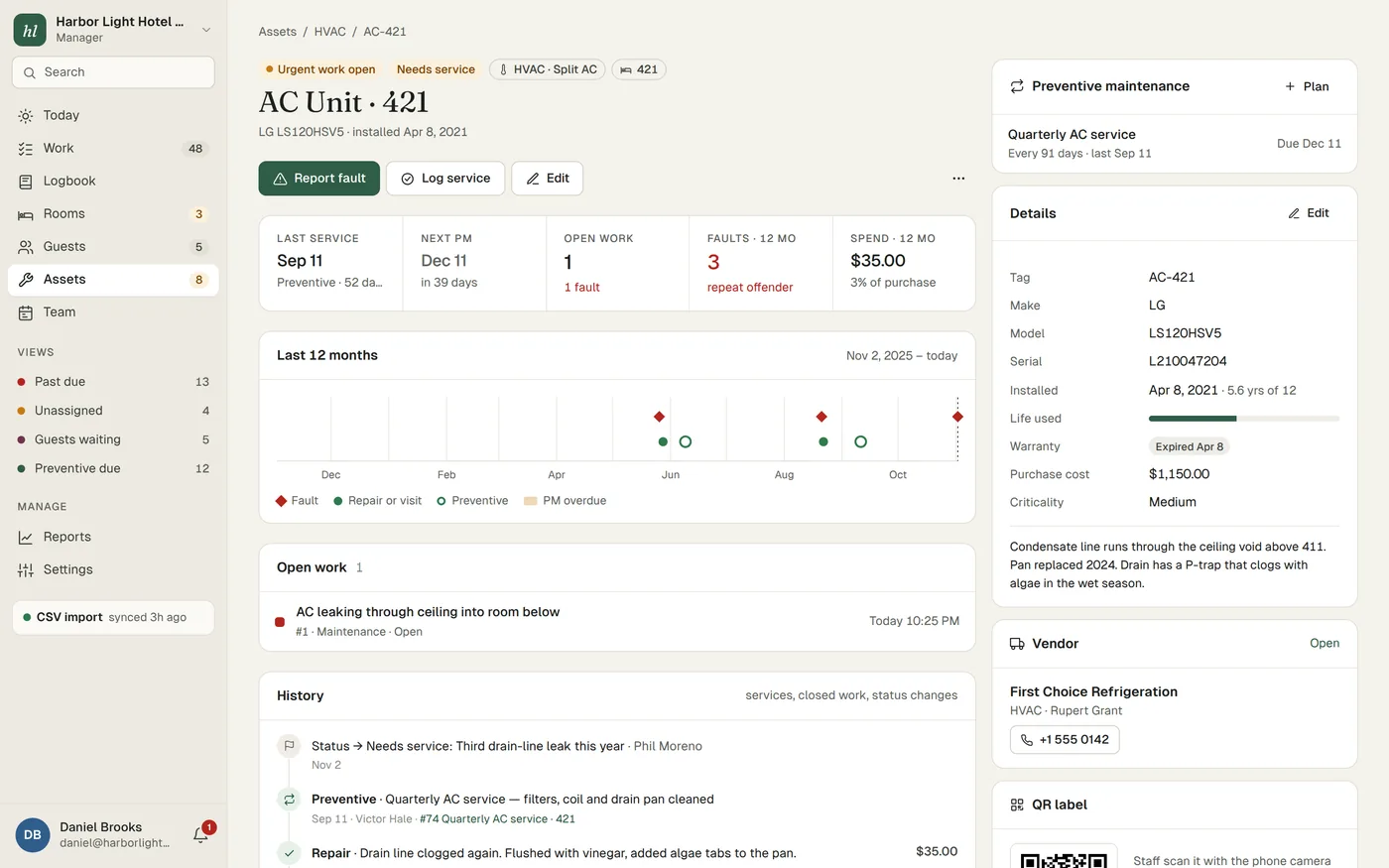
The rule only works if every job is recorded against the unit, not just the room. Turndown keeps each unit's service history and spend on its asset page and flags units with several faults in 12 months, so the pattern shows up without anyone having to remember it. See how asset history and preventive plans work.