What a backlog is, and when it becomes a problem
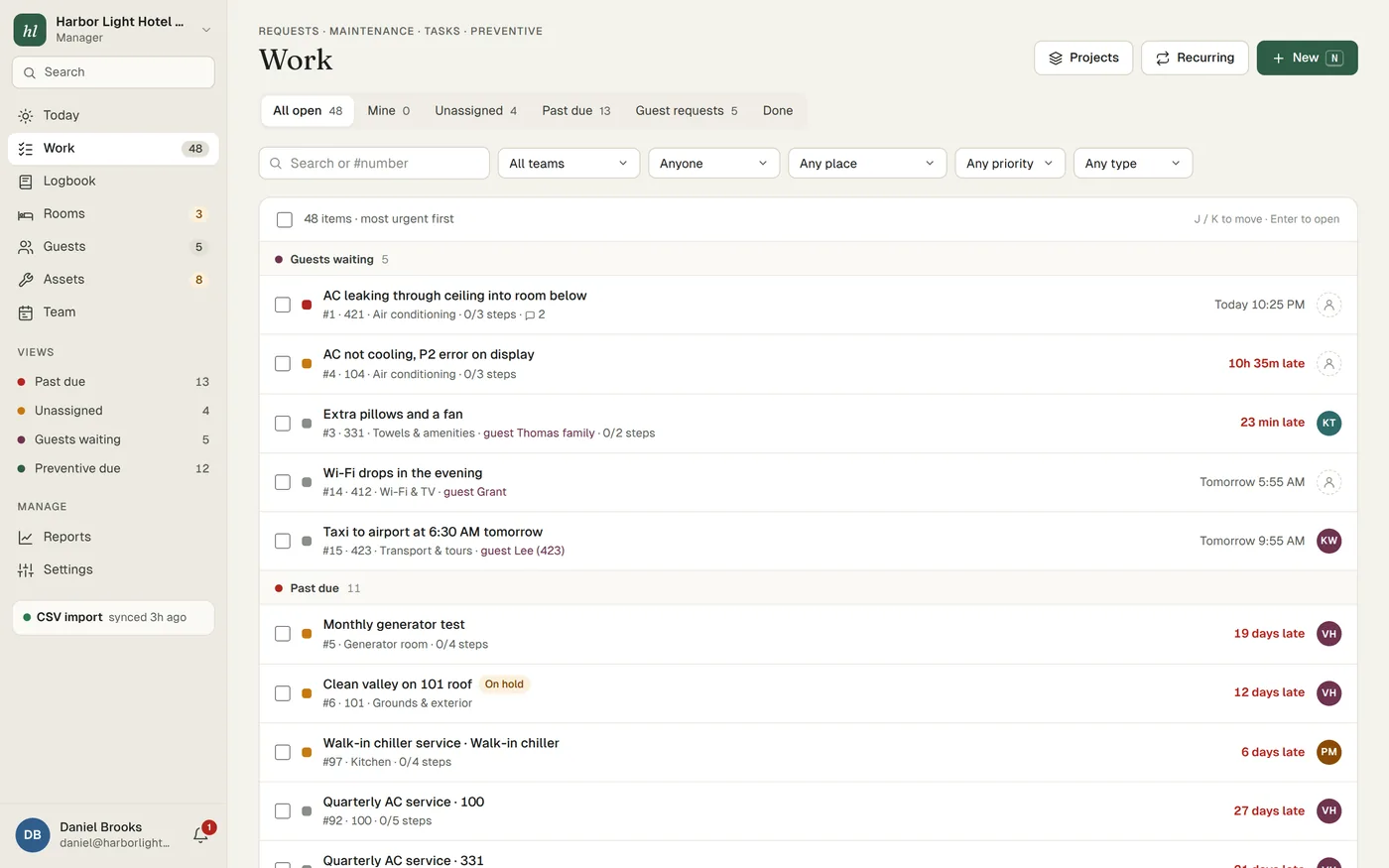
Your maintenance backlog is every job that is open and not yet done: the dripping tap in 214, the guest request for a second pillow that nobody marked done, the quarterly drain flush, the loose handrail on the pool steps. Every hotel has one, and a backlog of fresh, owned work is healthy. It means people are reporting problems.
A backlog becomes a problem in three ways:
- Jobs nobody ownsReported, sitting in a list, assigned to "maintenance" or to no one. These are the jobs that turn into guest complaints, because everyone assumes someone else has them.
- Jobs that are old and stuckPast their due date with no next step. Waiting for a part nobody ordered, a quote nobody chased, or a room nobody blocked.
- A list that only growsMore jobs created each week than finished. It happens slowly, so nobody notices until the list is too long to read, and then nobody reads it at all.
All three have the same cure: a short, regular review where a person reads the list and makes decisions. Software helps you see the list. It does not make the decisions.
Who, when and where
- WhoThe chief engineer or maintenance lead runs it. The general manager or operations manager attends, because some decisions need money or authority. The head of housekeeping joins when room access or room readiness is on the agenda, which is most weeks.
- WhenSame day and time every week. Monday morning works for most hotels: the weekend's problems are in, and the week's arrivals are known. Put it in the calendar as a standing meeting so it survives busy weeks.
- WhereIn front of the live list on a laptop or screen, not a printout. Decisions get entered as they are made: owner, date, status, note. A printout means someone has to type it all in afterward, and that step is where reviews die.
Thirty minutes is enough if you prepare the lists in advance and keep the discussion to decisions. If an item needs a longer conversation, give it an owner and a time to have that conversation outside the meeting.
The five lists to read
Don't read the whole backlog every week. Read these five views, in this order. Most maintenance systems can save them as filters. In a spreadsheet, a few sort and filter columns do the same job.
| List | What it shows | The question to ask |
|---|---|---|
| Past due | Every job past its target date, oldest first. | Who is doing this, and by when? If the honest answer is nobody, close it or re-plan it. |
| Unassigned | Jobs with no named person, especially guest requests. | Who owns it from today? A person, not a team. |
| On hold | Jobs paused for parts, a contractor, approval or room access. | Is the reason still true? What is the date we check again? |
| Oldest open | The ten oldest jobs, whatever their status. | Why is this still open? Is it really maintenance work, or a project in disguise? |
| Repeat faults | Rooms or units with several jobs in recent months. | Are we fixing the cause or resetting the symptom? |
Repeat faults deserve their own list because they hide well. Room 305's AC gets reset three times in a month by three different engineers, and each job looks small and closed. Put together, it is a unit with a blocked drain or a failing fan motor, and a guest who will not come back. In Turndown, units with several faults in 12 months are flagged automatically. Without software, sort your closed jobs by room and look for the same room number appearing again and again.
Three decisions: owner, next step or close
Every job you read gets exactly one of three decisions, made in under a minute.
1. Give it an owner and a date
One named person, and a date they agree to. "Marco, Thursday" is a decision. "Maintenance, this week" is not. If the owner isn't in the room, someone in the room tells them today.
2. Define the next step
If the job is blocked, the decision is the step that unblocks it, with its own owner and date. Order the shower cartridge today. Ask the contractor for a visit date. Get the GM's approval for a spend above the chief engineer's limit, ideally right there in the meeting. Block room 118 for Tuesday so the tiler can work. A job on hold without a next step is not on hold. It is forgotten.
3. Close it
Closing is a real decision, and often the right one. Close the job if it was done but never marked done, if it duplicates another job, if the room has since been renovated, or if you have decided not to do it. Write one line saying why, so nobody reopens the argument next month.
A 30-minute agenda
| Minutes | What you do | What comes out |
|---|---|---|
| 0 to 5 | Read the numbers: open jobs, past due, unassigned, jobs created and finished last week, age of the oldest job. | Is the backlog growing, shrinking or steady? |
| 5 to 15 | Past due and unassigned, oldest first. | An owner and date, a next step, or a close for every job. |
| 15 to 20 | On hold. | Each reason still true, each with a revisit date. |
| 20 to 25 | Repeat faults. | A decision per unit: inspect properly, repair the cause, or plan a replacement. |
| 25 to 30 | The week ahead: rooms needed for repairs and preventive work, contractor visits, VIP arrivals, rooms to take out of order. | Rooms agreed with housekeeping and the front desk. |
The last five minutes matter more than they look. Most stuck jobs in a hotel are stuck on room access: the engineer can't get into an occupied room, and the room is never empty at a useful time. Agreeing this week's rooms with the front desk, and taking a room out of order when the repair really needs it, unblocks more work than any other single habit.
What a good report looks like
After the review, send a short written summary to the GM and anyone who owns a job. One screen, not a document. People act on a list of names and dates. They skim a narrative. Here is the shape, with illustrative examples:
- The numbersOpen 64, past due 11, unassigned 0. Created 38 last week, finished 41. Oldest job 47 days.
- Past due, with decisionsRoom 214 shower mixer, waiting on a cartridge: Ana orders today, fit Wednesday. Pool gate closer: Marco, Tuesday. Lobby ceiling stain: roofer visiting Thursday, Carlos to meet him.
- Repeat faultsRoom 305 AC, third call in five weeks: full inspection and drain flush Monday, unit replacement quote if it fails again.
- Closed in the reviewSix jobs: three done but never closed, two duplicates, one superseded by the corridor repaint project.
- Needs a decision from managementReplace the laundry dryer motor or the dryer. Quote attached. Decide by Friday.
Keep last week's report next to this week's. If the same job appears three weeks running with a new date each time, the date is not the problem, and it needs a different decision.
We do this for our customers
This review is part of Turndown's service. Every Monday, a person from our team reads each customer's backlog and sends a short report: every overdue job with a suggested owner and next step, repeat faults flagged, and old jobs that look ready to close. Once a month we spend 20 minutes on a call looking at the trend together. It is included in the $299 monthly price.
We do it because we found that software alone does not empty a backlog. A busy chief engineer can always find a reason to skip the review this week. But everything on this page works without us. If you run the review yourself, every week, you will get most of the benefit.
Habits that keep the backlog small
The weekly review clears what has piled up. These habits stop it piling up in the first place.
- Every job gets one owner when it is createdNot at the next meeting. If your system can assign automatically by team or shift, use it, and let the person reassign if they must.
- Every priority has a target timeAgree what urgent, high, normal and low mean in hours or days, and set each job's due date from its priority. Without a target, "past due" means nothing.
- Done means closed, on the spotThe engineer closes the job on their phone at the job, with a photo. Jobs that are done but open make the backlog look bigger than it is, and hide the real ones.
- On hold always has a reason and a date"Waiting for part, check Friday" is honest. "On hold" alone is a place to hide work.
- Big jobs become projects"Reseal every bathroom on the third floor" is not one job sitting open for four months. It is a project with a job per room, so you can see progress and finish it.
- Wishes go on a separate listRenovation ideas and capital items belong in a capital plan, not the maintenance queue. Mixing them makes the backlog look permanently full.
- Common spares are stockedShower cartridges, toilet flappers, AC filters, lamps, door closers. If the same part has stalled jobs twice, keep two on the shelf.
- Repeat faults become preventionThree blocked drains in a wing is a preventive task, not three repairs. Add it to your preventive maintenance checklist.
- The numbers are visibleShare open, past due and oldest job with the whole team each week. People clear what they can see.
If your backlog is already out of control
A weekly review can't fix a list of several hundred jobs in one sitting. Do a one-time clean-up first, then start the weekly rhythm.
- Sort everything by age. Start with the oldest.
- Walk it. Take the list of old room jobs and check them in person, floor by floor. You will usually find many already fixed, duplicated or no longer relevant. Close them with a note.
- Group what is left by room. A room with five small jobs can often be done in one visit, with the room blocked for half a day.
- Hand out the cosmetic work. A block of painting, silicone and grout can go to a contractor for a week, freeing your team for the systems only they can fix.
- Re-prioritize honestly. Give every remaining job a priority, an owner and a target date from today.
- Start the weekly review the following Monday, and keep it even when the list looks small.
To see whether it is working over the months, track a few numbers: backlog size and age, on-time rate, and jobs created against jobs done. Our guide to hotel maintenance KPIs explains how to calculate each one and what can mislead.