The 3 PM question
At 2:45 the lobby fills up. A couple on their honeymoon are waiting for 312, a family wants two connecting rooms, and the front desk cannot say which rooms are actually ready. Someone radios the housekeeping supervisor, who is on the fourth floor checking a bathroom, and the answer comes back as "five minutes". In fact 312 has been clean for an hour. Nobody updated the PMS.
Housekeeping software for hotels fixes this by letting the person who finishes the room say so, from the room, and showing it to everyone at once. The front desk stops guessing, the supervisor stops running the stairs, and the couple get their key.
Room status, in plain terms
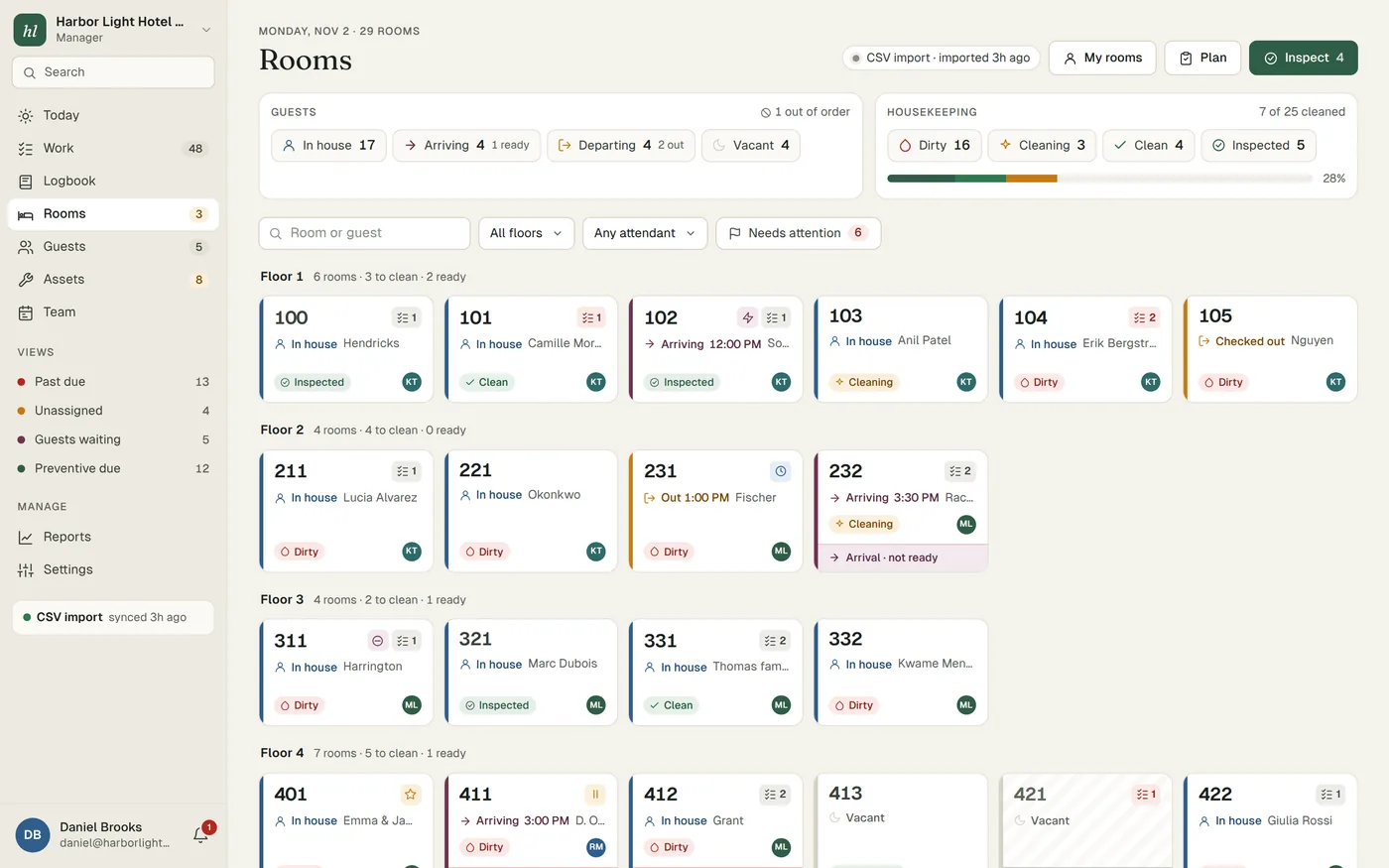
Most hotels use the same handful of statuses, though the names differ between systems. These are the ones on the Turndown room board.
| Status | What it means | What happens next |
|---|---|---|
| Dirty | The guest has left, or a stayover has not been serviced yet | An attendant cleans it |
| Cleaning | An attendant is in the room now | They finish and mark it clean |
| Clean | Cleaned, and waiting for a supervisor if you inspect | A supervisor inspects it |
| Inspected | A supervisor has checked it and signed it off | Ready for the next guest |
| Out of order | Cannot be used until something is repaired | Repair, then clean before it is sold |
| Out of service | Held back for a short time, for a minor issue or a deep clean | Return it to sale when ready |
The two that cause arguments are out of order and out of service. In most systems, out of order takes the room out of sellable inventory, for a burst pipe or a bathroom being retiled. Out of service is a short block on a room that still counts as available, such as a TV waiting for a replacement. Because they count differently in occupancy figures, check how your PMS treats each one and agree a rule with whoever does your revenue. Our guide to out-of-order rooms goes further.
How Turndown runs housekeeping
- A live room boardEvery room by floor, showing whether it is occupied, arriving or departing, and its housekeeping status. The front desk, the supervisor and the general manager all look at the same board, so there is one answer to "is 312 ready".
- Each attendant's rooms on their phoneAttendants see their own list for the day and change the status as they work. There is no paper sheet to collect at the end of the shift and no status to type in later.
- A daily plan based on creditsThe plan shares rooms out by credits, so a departure counts for more than a stayover. Nobody gets six checkouts while a colleague gets six stayovers.
- An inspection loopWhen an attendant marks a room clean, a supervisor inspects it. Clean, then inspected, so you know which rooms someone has actually checked.
- Rooms held while a repair is openIf a repair takes a room out of use, it is held out of order while the job is open and released when the job closes. Engineering closes the job and housekeeping sees the room come back, without a phone call.
- Arrivals that will not be readyThe manager's Today screen lists rooms that will not be ready for an arriving guest, and arrivals booked into a blocked room, while there is still time to move someone.
- Maintenance from the roomAn attendant who finds a loose towel rail or a dead bulb reports it from the same phone, with a photo, and it goes straight into the work queue.
Planning the day with credits
Counting rooms is the oldest way to plan housekeeping, and the least fair. Fourteen stayovers on one floor is a lighter day than ten departures spread across three floors, and attendants know it even if the plan does not.
A credit system gives each type of clean a weight. A common starting point is one credit for a departure and about half for a stayover, with more for a deep clean or a large suite. Add up the credits for the day, divide by the attendants on shift, and you have a fair target for each person. When someone calls in sick at 7 AM, you are moving credits, not arguing about room counts.
A few habits that make any plan work better:
- Arrivals first. Clean the rooms with guests arriving today before the stayovers, and early check-ins and VIPs before the rest.
- Keep people on their floors. Every trip to the linen room on another floor costs ten minutes. Give each attendant a run of rooms close together where you can.
- Check late checkouts at noon. A room still marked occupied at 1 PM is the one that will hold up an arrival. Ask the front desk early.
- Record do-not-disturb honestly. If the sign stays on, note it and try again after lunch. Do not mark it clean to make the board look finished.
When housekeeping and maintenance meet
Most of the friction in a hotel sits between these two teams. Housekeeping finds the problem, maintenance fixes it, and the room falls between them. A few rules help, whatever software you use.
- Report from the room, with a photoA photo of the cracked toilet seat tells engineering which part to bring. A note on a cart sheet tells them nothing until the end of the day.
- Never sell a room with an open urgent repairIf the AC in 421 is leaking, 421 is out of order until the job is closed. Hold the room as soon as the job is reported, not when the guest complains.
- Clean after every repairEngineers leave dust, footprints and a bed pulled away from the wall. A room coming back from out of order needs a clean and, if you inspect, an inspection before it is sold.
- Look at the same rooms twiceIf a room keeps coming up in maintenance, it is worth a walk-through with both teams. The pattern is usually obvious once you stand in it.
Connected to your PMS
Turndown reads rooms and reservations from Cloudbeds, Mews and Apaleo, so arrivals, departures and stayovers appear on the board without anyone typing them. Cleaning status goes back to the PMS within what each one accepts. For any other PMS, paste or upload a CSV of arrivals and departures. The board always shows when the last sync ran, so the front desk knows whether to trust it. We set the connection up for you during onboarding. See the integrations.
Who it's for
Turndown is built for independent hotels, boutique hotels, resorts and villa collections of roughly 20 to 150 rooms, where one supervisor often runs the floors, the laundry and the inspections. Every attendant, supervisor and front desk agent gets access, because users are unlimited. It costs $299 per property per month, month to month, with setup done for you and a 14-day trial with no card. See pricing.