Small teams work differently
In a 40-room hotel, the maintenance department might be one engineer and a handyman who also helps with luggage. The general manager covers the front desk at lunch. The housekeeper who finds the broken lamp is the same person who folds the towels. Nobody has an hour a day to update a system, and nobody has an IT department to call when it stops syncing.
Most maintenance software is built for someone else: a 600-room hotel with a director of engineering and a planner, or a factory with machines on a production line. Small hotels end up paying for features they never open, or they give up and go back to the notebook and the WhatsApp group. Small hotel and boutique hotel maintenance software has to start from the other end: what a team of six needs to see on a phone at 7 AM.
What a small hotel actually needs
Before you look at any product, write down what you need. For most independent hotels the list is short.
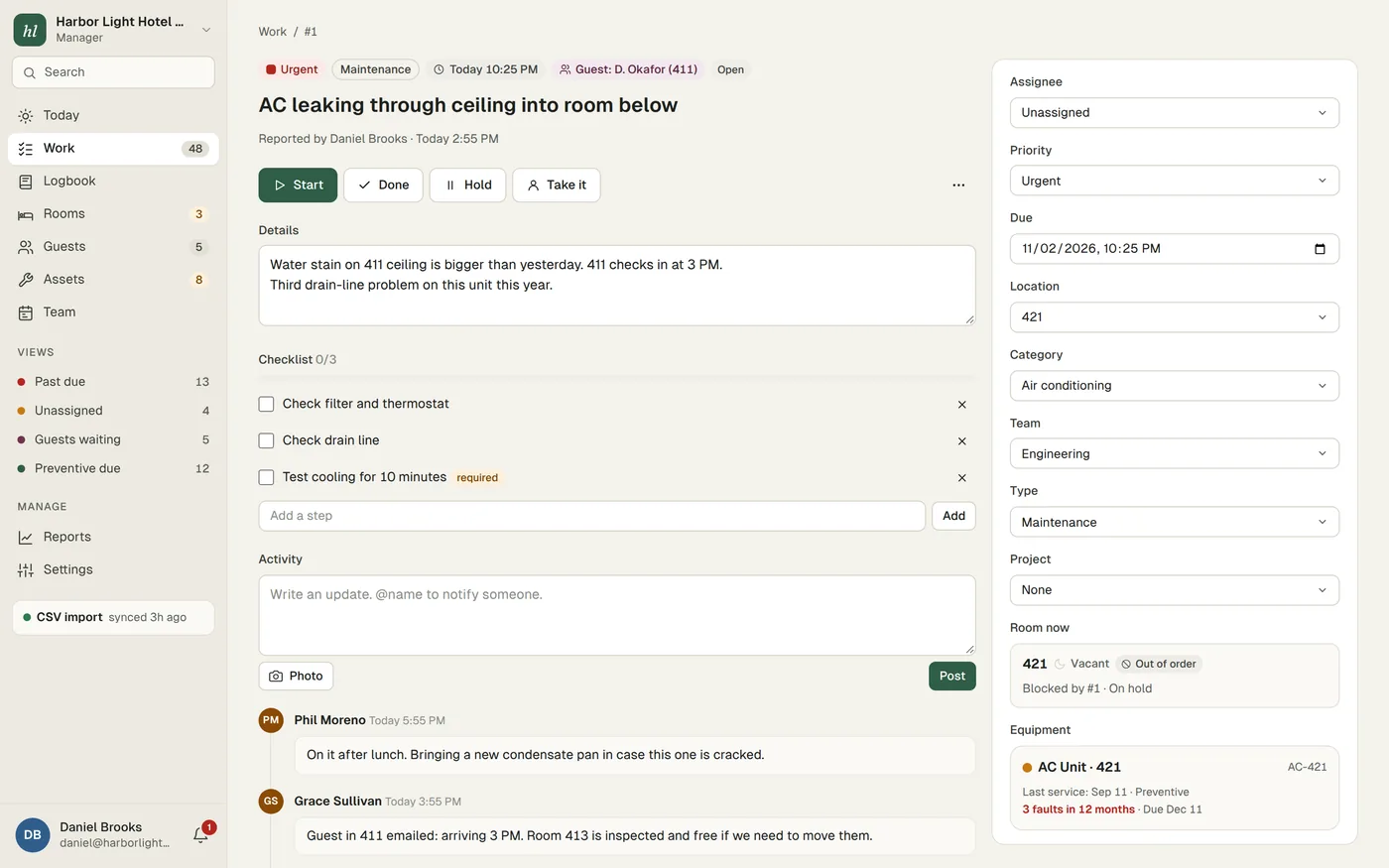
- Anyone on the team can report a problem from their own phone in under a minute, with a photo.
- Repairs, guest requests and planned work are in one list, so the engineer does not check three places.
- Every job has one owner and a time it is due.
- A room with an open repair cannot be given to an arriving guest by mistake.
- The handful of things that must happen on schedule do: AC filters and drains, the pool pump, the generator run.
- The night shift knows what the day shift knew.
- Someone looks at what is overdue every week.
- Setup does not take a month of your evenings.
Things you can do without, at least in the first year: multi-level approval chains, purchase orders, meter readings, and an asset form with 40 fields. If a feature needs a dedicated administrator to keep it running, a small hotel will not keep it running.
Why everyone needs a login
The person who finds a problem is rarely the person who fixes it. Housekeepers see the cracked tile, the front desk hears about the slow drain, and the night auditor notices the flickering corridor light. If they cannot report it themselves, the request goes through the radio or a sticky note, and that is where it gets lost.
When every login costs money, hotels ration them. The engineers get accounts and everyone else goes back to telling someone. Turndown includes unlimited users, so every housekeeper, front desk agent, night auditor and seasonal hire can have their own login on their own phone without anyone counting seats.
Why a flat price per property matters
Turndown costs $299 per property per month. That price does not change with the number of users or the size of the property, and it is month to month. For a small hotel, that does three useful things.
- The budget is predictableYou know the cost in January and in August. It does not jump when you hire twelve extra staff for the high season.
- Nobody is left out to save moneyAdding the new housekeeper or the summer intern costs nothing, so the person who spots the problem can always report it.
- There is nothing to negotiateNo setup fee, no contract, no add-on for the PMS connection or the weekly review. If it stops being worth it, you stop.
To be straight about it: a 25-room inn pays the same as a 140-room resort. For the smallest properties, the question is whether one place for every repair, a room board, guest requests and a weekly review by a person is worth less than $10 a day to you. The 14-day trial, with no card, is there so you can find out with your own team. See what's included.
How Turndown keeps it simple
- We do the setupSend us your room list, your equipment list if you have one, and your open issues. We import them, so your team starts reporting into a hotel that already looks like yours.
- Nothing to installIt runs in the phone's browser and can be added to the home screen. Each person stays signed in on their own phone for 30 days, reads it in their own language, and can keep working where there is no signal.
- One list for everythingGuest requests, repairs, recurring tasks, preventive work and inspections in one queue, each with an owner, a target time and a checklist. More about work orders.
- A Today screen with only the decisionsJobs more than a week past due, guest requests nobody has taken, and rooms that will not be ready for an arrival. If there is nothing on it, there is nothing to decide.
- Your PMS connectedRooms and reservations come from Cloudbeds, Mews or Apaleo, or from a CSV export of any other PMS. See the integrations.
- Your data stays yoursEach property's data is kept separate and backed up nightly. Export to CSV whenever you like, and if you leave, you get a full export.
A person to read the backlog
Large hotels have a director of engineering whose job is to look at the whole list. Small hotels have a general manager who means to do it on Friday and never gets to it. That is the gap the weekly review fills.
Every Monday, one of the Turndown team reads your backlog and sends a short report: every overdue job with a suggested owner and a next step, units with repeat faults, and old jobs that can be closed. Once a month we spend 20 minutes on a call looking at the trend with you. For a team without a maintenance manager, this is often the part that makes the difference. How a weekly backlog review works.
Your first month, whatever you use
- Week one: report everything. Ask every person on the team to report every problem they see, however small. The list will grow fast. That is the real backlog you already had.
- Week two: set priorities. Agree three or four levels and a target time for each. Keep the top level for leaks, safety and occupied rooms.
- Week three: plan the few things that matter. Put AC filters and drains, the pool pump, the generator run and the kitchen refrigeration on a schedule. Leave the rest for later.
- Week four: clean up. Go through everything overdue. Give each job an owner and a next step, or close it if it no longer matters. Then do the same next Monday.
Who it's for
Turndown is maintenance software for independent hotels, boutique hotels, resorts and villa collections of roughly 20 to 150 rooms. It suits properties with a small, hands-on team, where the same people cover maintenance, housekeeping and the front desk at different hours, and where nobody wants to become a software administrator.