What a good handover does
A shift handover has three jobs. It tells the next shift what is different from normal. It passes ownership of every open item to a named person. And it leaves a record someone can check next week. It is not a diary of the shift.
Most bad handovers fail in one of two ways. Either they are too long, a page of everything that happened, so the one thing that matters gets lost. Or they are too thin: "All quiet, nothing to report", while the guest in 214 was promised a fix by 10 PM.
Here is the test. Could the night auditor deal with a 2 AM call about room 214 using only this note? If yes, the handover did its job.
One structure for every department
Use the same order in every department, so anyone covering another desk knows where to look. Fill in only what applies, and write "none" rather than leaving a section blank, so the reader knows it was checked.
- Must know now. Safety issues, a guest at risk, a VIP arriving, anything that can't wait for the rest of the note.
- Open items. Every unfinished task, each with the room or place, what is done, the next step, who owns it now and by when.
- Rooms. Out of order and out of service rooms with return dates, room moves, rooms not ready for arrivals.
- Guests. Complaints in progress, promises made, special requests, guests who need a follow-up.
- Department items. Cash and keys at the desk, room status at housekeeping, plant readings and alarms in engineering.
- For information. Anything useful that needs no action. Keep this short.
Healthcare studies handovers closely because mistakes there are costly, and the WHO's guidance on communication during handovers recommends a standardized approach and read-back, where the receiver repeats the key information to confirm it was understood. Both translate well to a hotel.
Front desk shift report template
Copy this table into your log book, a shared document or your logbook software. The examples show the level of detail that helps.
| Section | What to write | Example |
|---|---|---|
| Shift | Date, shift, who hands over, who takes over. | Tue 3 Nov, PM to night. Ana to Joel. |
| Must know now | Safety, VIPs, guests at risk, system outages. | Card encoder slow; use the spare in the back office. |
| House status | In house, arrivals still due, departures not yet out, late checkouts agreed. | 6 arrivals due, 2 after midnight, both guaranteed. |
| VIPs and special attention | Who, room, arrival time, what is set up, what is still missing. | Mr. Patel, 501, ETA 11:30 PM. Fruit plate in room. Late dinner booked. |
| Rooms | Out of order and out of service rooms with return dates. Room moves. Rooms not ready. | 214 out of order, no hot water, back Thu. 118 guest moved to 120. |
| Complaints in progress | Guest, room, issue, what was promised, by whom, by when. | 305 AC noisy. Engineer booked 9 AM. Offered late checkout. |
| Open requests | Wake-up calls, taxis, transfers, parcels, messages, bookings to confirm. | Wake-up 412 at 5:15 AM. Airport taxi 5:45 AM for 2 guests. |
| Cash and keys | Float counted and agreed, discrepancies, master keys signed out and back. | Float correct. Master key 3 still with engineering. |
| Incidents | Anything reported, who was told, reference numbers. Keep personal details to what is needed. | Noise complaint about 208 at 10:40 PM; guest spoken to. |
| Lost and found | Items logged this shift, guests to contact. | Phone charger from 216, logged. |
| Next shift must | The one to three things that must happen. | Confirm 501 arrived. Chase 214 parts with engineering at 7 AM. |
For the night audit, add the audit status, reports run, any rate or posting corrections, and accounts over their credit limit.
Housekeeping handover template
Use this between the morning and afternoon supervisors, and from the afternoon team to the evening or turndown service.
| Section | What to write |
|---|---|
| Shift | Date, shift, who hands over, who takes over. |
| Must know now | Rush rooms for waiting arrivals, a guest welfare concern, a safety issue such as a wet floor or broken glass. |
| Room status | Counts of dirty, in progress, clean, inspected, out of order and out of service rooms. |
| Rooms not finished | Room number and why: do not disturb, guest in room, service refused, waiting for maintenance. |
| Do not disturb | Rooms on do not disturb long enough to need a check under your welfare policy, and whether the front desk knows. |
| Maintenance reported | Room, problem and job number, and whether it is still open. |
| Guest requests | Extra beds, cribs, amenities and anything promised but not yet delivered. |
| Lost and found | Items found and logged. |
| Linen and supplies | Shortages, laundry running late, anything to order. |
| Team | Who is off, who is covering, keys and devices returned. |
| Next shift must | The one to three things that must happen. |
Engineering handover template
Engineering handovers carry the most safety risk. A circuit locked off for work, a fire panel in fault or a contractor still on the roof must never be left out.
| Section | What to write |
|---|---|
| Shift | Date, shift, who hands over, who takes over. |
| Must know now | Fire panel faults, gas or water leaks, a lift out of service, anything that affects safety tonight. |
| Isolations | Equipment locked or tagged out, why, who holds the lock, and when it will be restored. |
| Plant readings | Readings outside normal for water heaters, chillers, pumps, pool chemistry and the generator, and what was done. |
| Alarms | Every alarm this shift, cause, action, and whether it has cleared. |
| Jobs in progress | Room or asset, fault, what is done, what is next, parts on order, job number. |
| Rooms | Out of order rooms and return dates. Guests promised a fix, and by when. |
| Contractors | Who was on site, who is due tomorrow, permits open, work areas left cordoned. |
| Keys and tools | Master keys, plant room keys and radios, and who has them. |
| Next shift must | The one to three things that must happen. |
Out of order rooms deserve a line in every department's handover, not just engineering's. Our guide to out of order rooms explains how engineering, housekeeping and the front desk keep that list short.
Incident entries in the log book
A slip by the pool, a guest taken ill, a water leak into a room below, a police visit. Incidents need a fuller entry than routine items, written during the shift while details are fresh, because they may be read later by an insurer, a manager or a lawyer. Use the same fields every time:
- Date, time and exact place.
- Who was involved, and who saw it, with room numbers or staff names.
- What happened, in plain facts. Write what you saw and heard, not what you think caused it.
- What was done straight away: first aid, area cordoned off, water shut off, guest moved.
- Who was told and when: duty manager, security, emergency services, the guest's contact.
- Photos taken, and where they are kept.
- Follow-up needed, who owns it and by when. This line carries over into every handover until it is closed.
Follow your company's incident procedure and your insurer's reporting rules where they ask for more. The log entry is the starting record, not a replacement for a formal report.
How to make handovers actually get read
A perfect template that nobody reads is worth nothing. These habits make the difference.
- A short face-to-face momentFive minutes at the desk or in the office, with the written note open. The outgoing person talks through "must know now" and the open items. The incoming person reads back the open items in their own words.
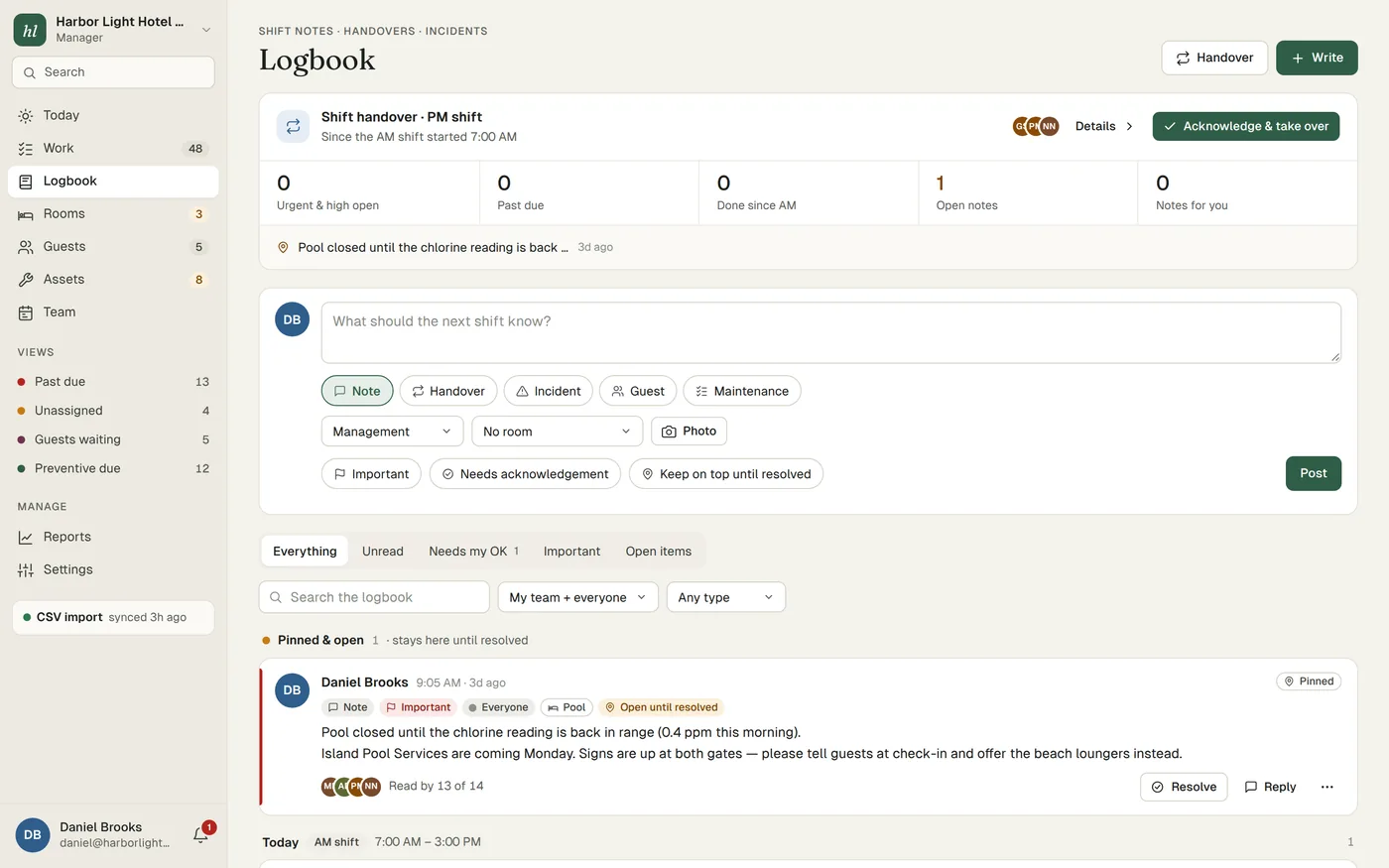
- Acknowledgement means taking overThe incoming person confirms they have read the note and taken over its open items, with a signature in a paper log or a button in a digital one. Until then, the outgoing person still owns them. A handover nobody has acknowledged by mid-shift goes to the manager.
- Open items carry over until closedAn unfinished item stays at the top of every handover until someone closes it, with the date it was first raised. Rewriting it from memory each shift is how items quietly drop off. Standing notes, such as "pool closed until Friday", stay pinned until they expire.
- Write for the next personOne line per item, with room numbers, names and times. "305 AC noisy, engineer 9 AM, guest offered late checkout" beats a paragraph.
- The handover points to the workA repair goes into the maintenance system as a job, and the handover gives the job number. The logbook is where you tell people. The work queue is where it gets done and tracked.
- Keep guest details minimalWrite what the next shift needs to act, nothing more. No card numbers, and no health details beyond what is needed to help the guest.
- Managers read the weekOnce a week, the GM or operations manager reads the handovers for patterns. The same broken encoder in five handovers is a purchasing decision, not five notes. Bring maintenance patterns to the weekly backlog review.
Paper log book or digital logbook
A paper log book can work well. Use a bound book with numbered pages, so pages can't be removed. Write in pen, date and sign every entry, and have the incoming person sign under it. Rewrite open items at the start of each shift until they are closed.
Its limits are practical. It lives in one place, so the engineer on the fourth floor or the manager at home can't see it. Old entries can't be searched, and nobody can tell who has read what. Carry-over depends on someone rewriting each item, every shift.
A digital logbook removes those limits, provided it keeps the same structure. Turndown's logbook keeps shift notes, handovers and incidents on every phone, with read receipts and an "Acknowledge and take over" step. Notes marked open until resolved carry over from shift to shift until someone closes them. See how the shift logbook works.
Whichever you choose, start with the structure on this page. Teams that already write good handovers on paper usually write even better ones on a phone. A team that writes "all quiet" on paper will write "all quiet" in an app too, until the habits change.