Why preventive maintenance slips in hotels
Most hotels have a PM plan. It lives in a binder in the engineering office or a spreadsheet the last chief engineer built, and it was followed carefully for about two months. Then a busy weekend came, the guest calls piled up, and the filter cleaning planned for March happened in July, after three guests complained about a musty smell.
Planned work is not skipped because engineers do not care. It is skipped because it never shows up next to the urgent jobs. A leak in 214 has a guest attached to it. A drain line due for flushing does not. Preventive maintenance software fixes that by turning each plan into a real job, with a due date and an owner, in the same queue your team already works from.
What belongs on a hotel PM schedule
Start with the equipment that hurts guests or safety when it fails. The table below is a starting point, not a standard. The right interval depends on the equipment, your climate and your occupancy, so check your manufacturer's manual and your local codes, and use licensed contractors where the law requires them.
| Equipment | Typical tasks | Often scheduled |
|---|---|---|
| Guest room AC units | Clean or change filters, flush the condensate drain, check the coil and the cooling | Monthly to quarterly, more often in heavy use |
| Guest rooms | Walk the room: taps, shower seals, grout, door closer, safe, lights, TV, furniture | Quarterly or twice a year per room |
| Pool and spa | Pump and strainer basket, filter pressure, backwash, chemical feeders | Weekly checks, with water testing as your health code requires |
| Generator | Run test, fuel level, battery, coolant, transfer switch | Per the manufacturer and local code |
| Hot water and boilers | Temperatures, safety valves, flushing low-use outlets | As your water management plan sets out |
| Kitchen | Walk-in door gaskets and temperatures, hood filters, ice machine | Weekly to quarterly, plus vendor service |
Two of these deserve particular care. If your generator is a required emergency power system, local codes often refer to NFPA 110 for how it is tested and maintained; ask your electrician or fire authority which rules apply to you. For hot water, the CDC recommends that hotels have a water management program to reduce the risk of Legionella, and has guidance for hotel owners and managers. Our hotel preventive maintenance checklist goes through the rest area by area.
How Turndown handles preventive maintenance
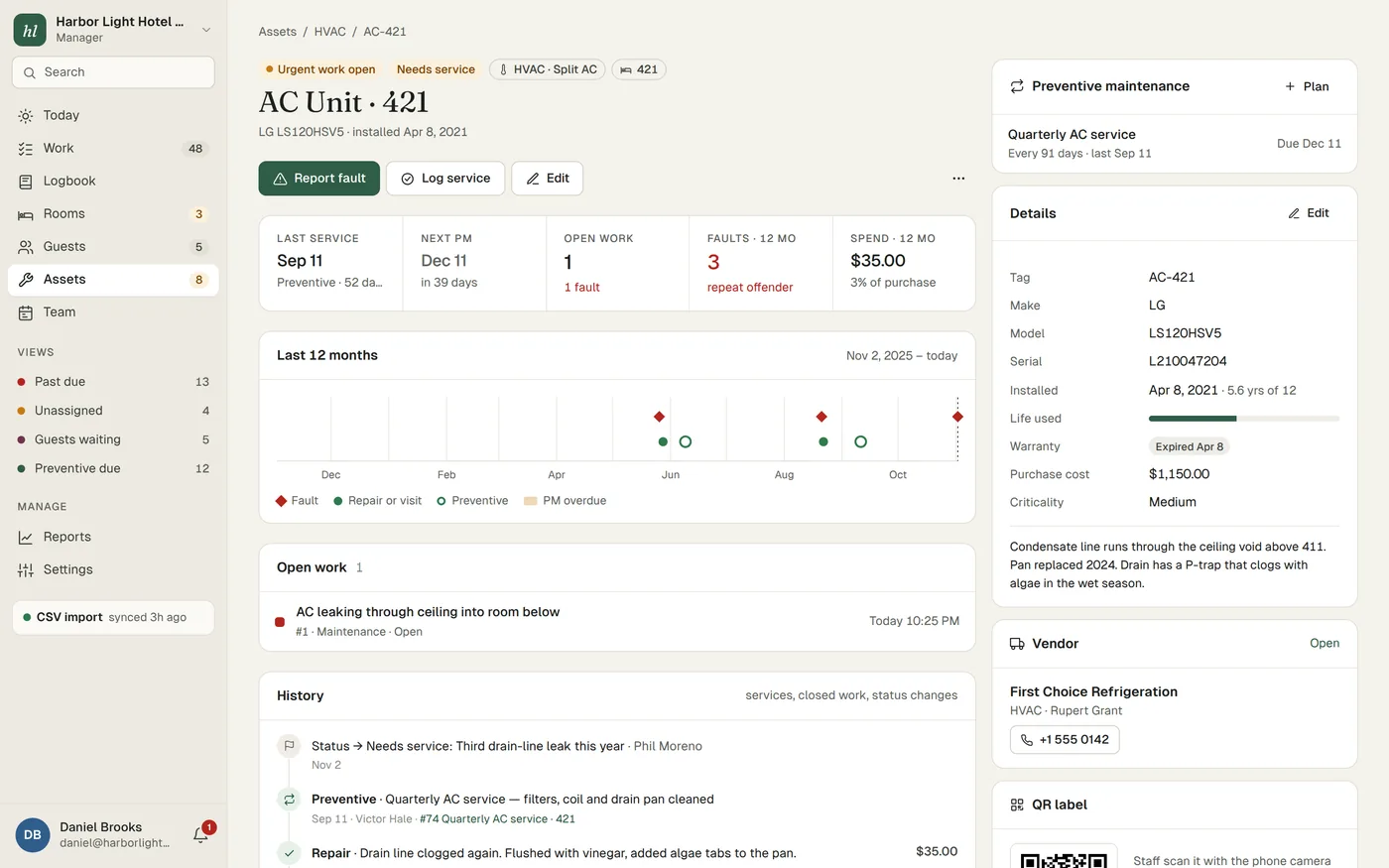
- An asset registry with QR tagsEvery AC unit, pump, boiler, chiller and generator has a page with where it is, its service history, what it has cost you and the vendors who look after it. Stick its QR tag on the unit, and the engineer standing in front of it can scan and open that page.
- Plans that create their own workSet a preventive maintenance plan and Turndown creates the work automatically on schedule. Nobody has to remember to open the binder.
- In the same queue as everything elsePM jobs sit in one list with guest requests, repairs and inspections, each with a due date and an owner. The engineer sees the drain-line flush next to the dripping tap and can do both on the same floor.
- Checklists that must be finishedEach job can carry a checklist. Mark the steps that matter as required, such as "flush the drain and confirm it runs clear", and the job cannot be closed until they are ticked.
- Repeat faults flaggedA unit with several faults in 12 months is flagged as a repeat offender. Three calls about the AC in 421, all at the drain line, is a pattern worth a decision, not three unrelated jobs.
- Routines for the restNot everything is an asset. Recurring routines cover the weekly roof walk, the monthly generator run and the quarterly room walk.
- Reports by categoryOn-time rate, resolution time and backlog age, broken down by team, category, place and person, so you can see whether planned work is keeping up. Export to CSV whenever you like.
Building a PM plan that survives busy season
A plan that is too big gets abandoned. These habits keep it alive, whatever software you use.
- Start small. Put the guest room AC, hot water, pool, generator and kitchen refrigeration on the plan first. Add the rest once those run on time for a couple of months.
- Spread the work out. Sixty AC units due on the first Monday of the month will not get done. Two or three a day across the month will.
- Do room work when the room is empty. Plan guest room PM around departures and low-occupancy days. Save the jobs that take a room out of order for the quiet season.
- Write checklists a new engineer can follow. "Service AC" means something different to everyone. "Remove and wash filter, flush drain with water, run 10 minutes and check air temperature" does not.
- Record what you found, not just that it was done. "Drain line half blocked with algae" is the note that tells you to shorten the interval for that unit.
- Watch the PM on-time rate on its own. If planned work keeps sliding past due, the plan is bigger than the team. Cut it back, move tasks to a contractor, or make the case for more hours. Pretending it is getting done is the worst option.
In hot, humid places, AC is where most of the effort goes. Our guide to AC maintenance in hot, humid climates covers drain lines, filters and coils in more detail.
Repair or replace
Every engineer knows the unit that eats their week. The trouble is proving it to the owner. Because each asset page shows its full service history and spend, the case is already written: how many faults in the last year, what they were, and what the unit has cost you. When a ten-year-old unit has cost more in repairs this year than a new one would, the numbers make the argument for you.
Every Monday, a person from Turndown reads your backlog and sends a short report. Overdue preventive work gets a suggested owner and a next step, and repeat faults are called out so they reach a decision instead of another repair. How the weekly backlog review works.
Who it's for
Turndown is built for independent hotels, boutique hotels, resorts and villa collections of roughly 20 to 150 rooms, where a small engineering team looks after everything from the pool pumps to the kitchen walk-in. We set it up for you: send us your equipment list, your rooms and your open issues and we import them. It costs $299 per property per month, month to month, with unlimited users and a 14-day trial with no card. See pricing.