Which rules apply to your generator
A generator that has not run under load for six months is a guess. The night the power goes out, with 80 rooms occupied, a full kitchen and guests in the elevator, is the wrong time to find out whether the battery is flat or the fuel has gone bad. A short weekly look and a proper monthly test turn the guess into a fact.
Which rules apply depends on what the generator powers and where you are. NFPA 110, the Standard for Emergency and Standby Power Systems, covers generators that a building or life safety code requires, such as those that power emergency lighting. Many hotel generators are optional standby units that keep pumps, elevators, kitchens and the lobby running. For those, the manufacturer's manual is the rule book, and NFPA 110 is still a good model.
The intervals on this page come from the Minnesota Department of Health's Inspection and Testing of Emergency Generators (revised June 2024), a clear summary of NFPA 110 (2010 edition). It is written for health care facilities, so some parts go further than a hotel needs. Your local code and your fire marshal decide what applies to you. Ask them, and write the answer at the top of your log.
Downloads: the generator test log as a spreadsheet (XLSX), with tabs for the monthly test and the weekly inspection, or the monthly test log as CSV. The page also prints clean.
Every week: the inspection
The weekly inspection is a walk-around, not a load test. It takes 15 minutes once your engineer knows the set. The Minnesota summary lists what it should cover at a minimum.
- Fuel: main tank and day tank levels, day tank float switch, piping, hoses and connectors, fuel pressure, and nothing blocking the tank vents or overflow.
- Lubrication: oil level, and the oil heater if there is one.
- Cooling: coolant level, water pump, jacket water heater, belts, hoses and fan.
- Exhaust: condensate trap drained, no signs of leaks.
- Battery: no corrosion, charger working, electrolyte level where the battery has one. Maintenance-free batteries follow the manufacturer's instructions.
- Electrical: a general look at wiring and connections, circuit breakers and fuses.
- The engine and generator: no debris or loose fittings, guards in place, and nothing unusual in vibration, leaks, noise or temperature.
- The room: no linen, furniture or boxes stored around the set, louvers clear, the door locked and the emergency stop guarded.
- The log: write the hour meter reading and your initials.
Starting the set briefly during the weekly check is fine if the manufacturer allows it, but a short run without load is not the monthly test, and the Minnesota summary notes that short runs can harm the engine. Running long enough to reach operating temperature matters.
Every month: the test under load
This is the test that proves the generator will carry the building. NFPA 110, as the Minnesota summary describes it, asks for:
- A diesel generator exercised at least once a month for at least 30 minutes under load.
- A load that either keeps the manufacturer's recommended minimum exhaust gas temperature, or is at least 30 percent of the nameplate kW rating. A 100 kW set needs at least 30 kW.
- Warm-up and cool-down time not counted in the 30 minutes.
- Gas, propane or gasoline sets run with the available load for 30 minutes, or until water temperature and oil pressure have stabilized.
- The test started by simulating a power failure with the test switch on the automatic transfer switch.
- A cold start, not a set that has just been run.
- At least 5 minutes of running unloaded before shutdown to cool the engine, or longer if the manufacturer says so.
NFPA 110 does not set a day or time for the test. You choose one. In a hotel, pick a quiet hour and tell people first. When the transfer switch moves the load, lights can blink, elevators can pause and the front desk computers can restart if they are not on a UPS. A note to the front desk, the kitchen and security the day before saves a lot of alarmed calls.
If the set ran during a real power cut, long enough and with the readings recorded, that run can count as the month's test.
Every month: the transfer switch
The automatic transfer switch decides whether the hotel gets power from the street or the generator. The Minnesota summary says to operate each transfer switch monthly, moving it from normal to the alternate source and back, and to inspect it regularly, with monthly recommended.
- Operate the switch with its test function, from normal to generator and back to normal.
- Record the transfer time.
- Look for signs of overheating or worn contacts. Terminals and connectors should be their normal color.
- Listen for unusual sounds.
- Keep it free of dust and dirt, with covers tight and doors closed.
Opening breakers to simulate an outage carries a real risk of shock and arc flash. Only trained people with the right protective equipment should do it, and a dedicated test switch is the safer way. The summary also suggests an infrared scan of the transfer switch once a year to find loose connections before they fail.
Every year
- The manufacturer's annual service: oil and filters, fuel filters, coolant, belts, hoses and the battery, as the manual sets out. Usually a contractor visit.
- The load bank test, if your monthly tests can't reach the required load.
- Fuel quality. Diesel stored for a long time can grow sludge and water. Your fuel supplier or generator contractor can test and polish it.
- A review of the year's log: missed weeks, readings that drifted, problems that came back.
NFPA 110 also sets tests every 36 months for the highest-risk systems, called Level 1, where a failure could cost lives. Most hotel standby sets are not Level 1, but if yours powers life safety loads, ask your contractor or fire marshal which level it is.
Before storm season
Hotels in hurricane and storm regions should treat the start of the season as a test date of its own.
- Fill the fuel tanks and confirm a delivery contract for a long outage.
- Know how many hours the set runs on a full tank at your normal load.
- Keep spare oil, oil and fuel filters, and belts on site.
- Write down which circuits the generator carries: pumps, elevators, kitchen fridges and freezers, the lobby, the front desk, emergency lighting.
- Brief the night team on what happens when the power goes out and who to call.
The test log
A test that is not written down did not happen, as far as an inspector or an insurer is concerned. The Minnesota summary lists what the monthly record should hold. Fill in the generator's details once at the top: its name, when it was installed, its nameplate kW, 30 percent of that, the fuel type and its normal operating temperature. Then one line per test.
| Date | Hour meter start | Hour meter stop | Minutes under load | Load kW | Oil pressure | Operating temp | Exhaust temp | Transfer switch and time (s) | Cool-down (min) | Problems and action | Initials |
|---|---|---|---|---|---|---|---|---|---|---|---|
| Nov 3 | 1,204.5 | 1,205.3 | 35 | 42 | 48 psi | 185 °F | 650 °F | ATS-1, 8 | 5 | None | VH |
The first line is an example only. Your manual gives the normal oil pressure and temperatures for your set. The written record should also include who did the work, anything that was not right and what was done about it, including parts replaced. Keep it on site where the fire inspector can see it.
Running it in Turndown
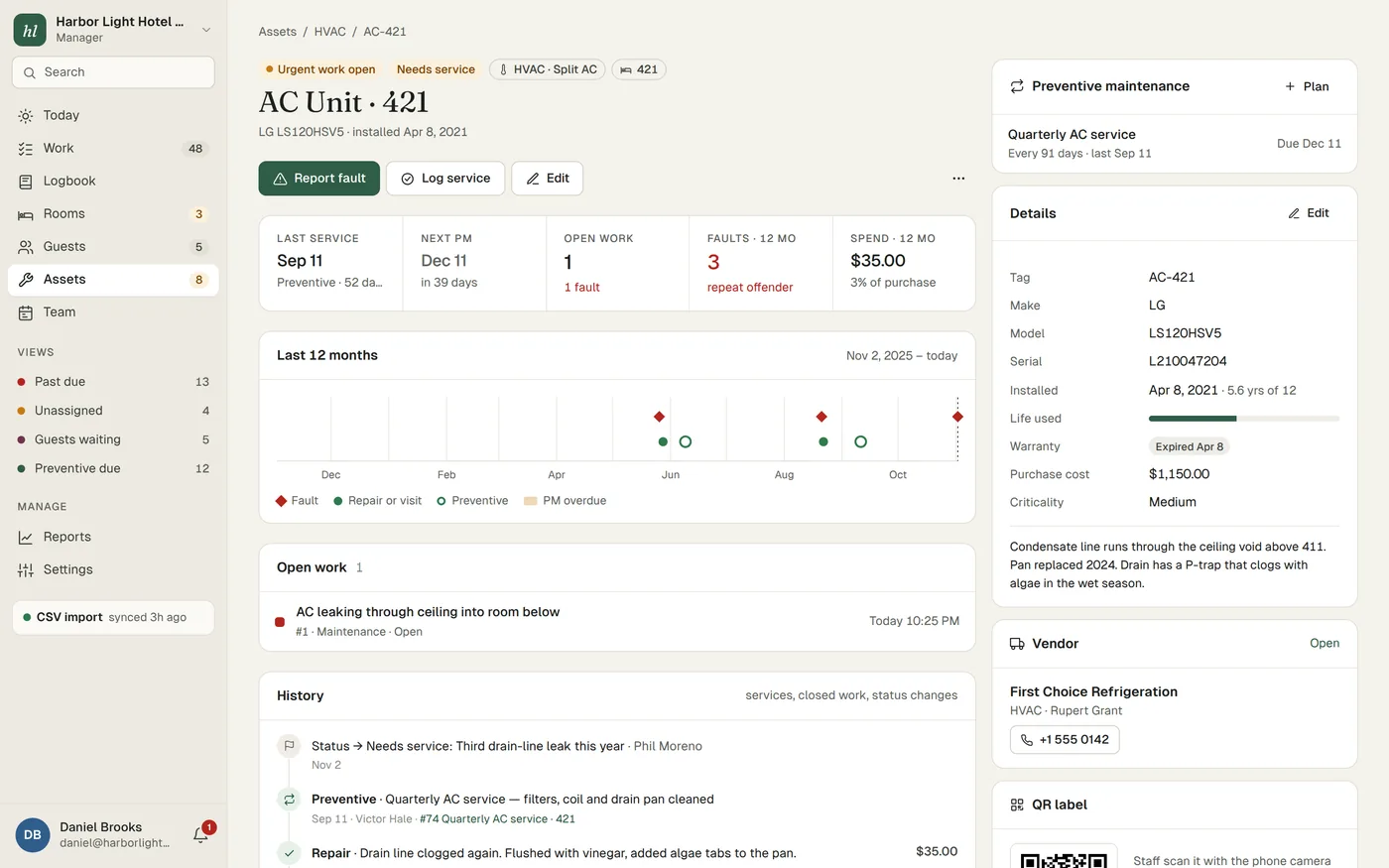
Turndown's preventive maintenance library has two generator plans: a weekly test run (check fuel, oil and coolant, run for 15 minutes, log run hours) and a yearly generator service whose required steps, checking oil and coolant and running under load for 30 minutes, must be ticked before the job can close. If your code requires the monthly test under load, add it as your own plan with the steps from this page. Each plan creates its job ahead of the due date, and every run lands in the generator's history.
A QR tag on the generator opens that history for any signed-in engineer, with a button to report a fault. If the monthly test slips, it can show up in the Monday backlog review as an overdue job with a suggested owner and a next step. See how a year of generator, pump and AC work fits together in the preventive maintenance schedule builder.