Two inspections, one route
Most hotels inspect rooms in two different ways, and both work better with the same route and the same rules.
- The supervisor's daily inspectionDone after the room is cleaned and before it is released for sale. It checks what the next guest will see and touch in the first ten minutes: cleanliness, amenities, lights, the TV, the AC, hot water. It is quick, and it happens every day.
- Engineering's room visitA full maintenance check of the room, done about once a quarter per room. It goes behind the obvious: the drain pan under the AC, the silicone around the bath, the door closer, the GFCI outlet. It finds the faults before a guest reports them.
The tables below mark each line H for the housekeeping inspection, E for the engineering visit, or both. A supervisor checks the H lines every time. Engineering checks every line on its visit. The route is the same, so a supervisor who spots an E problem can write it down without changing how they walk the room.
This page is about the method and the pass rules. For the full maintenance program by area and frequency, from the plant room to the generator, use the hotel preventive maintenance checklist.
How to walk the room
A fixed route means nothing gets skipped and every inspector finds the same things.
- Start outside the door. Look at the room number, the door and the corridor carpet the way an arriving guest does.
- Enter with a guest key. If the lock fails on a guest key, you have found the first fault before you are inside.
- Go clockwise, top to bottom. Ceiling, walls, furniture, floor. The ceiling is where water stains show first, and most people never look up.
- Use everything once. Switch on every light. Flush the toilet. Run the shower until it is hot. Turn on the TV and change the channel. Sit on the bed and the chair. A guest will do all of this within an hour.
- Finish at the bathroom, then the balcony. Water needs a few minutes to run hot, so turn the shower on first and check it last.
- Write it down in the room. Not at the end of the floor. A fault remembered later is a fault half the time.
Carry a small kit so the easy fixes happen on the spot: spare bulbs of the types your rooms use, remote and lock batteries, a screwdriver set, a flashlight and a few door stops. Engineering adds a thermometer for the AC outlet and a socket tester.
Pass and fail rules, room by room
Each line has one rule. If the room meets it, it passes. If not, it fails, even if it is "nearly there". Clear rules stop arguments between housekeeping and engineering, and they make your scores mean the same thing every week.
Entry and door
| Check | Passes when | Who |
|---|---|---|
| Guest key | Opens on the first try, with a green light and no delay. | H, E |
| Door closing | Closes and latches by itself from fully open, without slamming. | H, E |
| Deadbolt and latch | Both engage fully and release smoothly from inside. | E |
| Door and frame | No chips, peeling paint, scuffs at kick height or a loose number plate. | H, E |
| Evacuation plan | Present on the door, readable, showing the right room and route. | H, E |
| Connecting door | Locked, with no light or noise coming through the gap. | H, E |
Bedroom and living area
| Check | Passes when | Who |
|---|---|---|
| Lights | Every bulb works, and bulbs in the same room are the same color. | H, E |
| Switches and sockets | Tight to the wall, no scorch marks, bedside sockets and USB ports charge a phone. | E |
| Bed | Silent and steady when you sit on the edge. Headboard does not move. | H, E |
| Furniture | Drawers run, handles tight, chair legs firm, no sharp edges. | H, E |
| TV and remote | Turns on with the remote, shows the welcome channel, changes channel. | H |
| Phone | Dial tone, speed-dial labels correct. | H |
| Safe | Opens and closes with a test code, and with the master code on engineering visits. | H, E |
| Minibar or fridge | Cold inside, quiet, door seals all the way round. | H, E |
| Curtains | Run end to end and close fully with no light gap at the center. | H, E |
| Walls and ceiling | No stains, cracks or dents you can see from the bed. Any ceiling stain is a fail. | H, E |
| Floor | No lifting carpet edges, loose tiles or stains that a clean did not remove. | H, E |
AC and air
| Check | Passes when | Who |
|---|---|---|
| Cooling | Cool air at the outlet within a few minutes of switching on. | H, E |
| Noise | No rattle, buzz or dripping sound at normal fan speed. | H, E |
| Water | No drips, stains or damp patches under or around the indoor unit. | H, E |
| Filter and drain | Filter clean, drain pan clean and draining freely. | E |
| Thermostat or remote | Responds at once and shows a sensible room temperature. | H, E |
| Smell | No musty smell when the unit starts. A musty start is a fail. | H, E |
Bathroom
| Check | Passes when | Who |
|---|---|---|
| Hot water | Runs hot at the shower within a minute and holds steady. | H, E |
| Shower spray | Even spray from all jets, no scale, head tight on the arm. | H, E |
| Toilet | Flushes fully, refills and stops. No running sound after a minute. | H, E |
| Toilet fixing | Bowl does not rock. Seat and lid tight. | E |
| Taps | No drip after closing, handles tight. | H, E |
| Drains | Basin, bath and shower drain without standing water. | H, E |
| Silicone and grout | Continuous, with no gaps, black spots or lifting edges. | H, E |
| Extractor fan | Runs, and holds a sheet of toilet paper against the grille. | E |
| Rails and hooks | Towel rail, grab bar and robe hook hold when pulled firmly. | E |
| GFCI or RCD outlet | Trips with the test button and resets. | E |
| Hair dryer and mirror lights | Work, cord undamaged. | H, E |
| Under the basin | Dry. Shut-off valves turn by hand. | E |
Windows, balcony and safety
| Check | Passes when | Who |
|---|---|---|
| Windows and balcony door | Open, close and lock without force. Seals intact, tracks clear. | H, E |
| Restrictors | Where fitted, stop the window at the set opening. | E |
| Balcony railing | Solid when pushed, no loose fixings or rust at the base. | E |
| Balcony floor | Drains, no standing water, no trip edges. | H, E |
| Smoke detector | Present, uncovered, undamaged, with its light showing normal where it has one. Testing follows your fire alarm schedule. | H, E |
| Pests | No droppings, insects or marks at the bed seams, skirting or under the sink. | H, E |
Stop items: the room does not go on sale
Some faults make a room unfit for a guest, whatever the rest of the score. If any of these fail, the room stays off sale until it is fixed.
- The door does not lock, or the guest key does not work.
- The smoke detector is missing, covered or damaged.
- Broken glass, a loose railing or exposed wiring.
- A gas smell, a burning smell or a scorch mark at a socket.
- An active water leak, from the ceiling, the AC or under the basin.
- No hot water, or a toilet that does not flush.
- No cooling in a hot climate, or no heat in a cold one.
- Signs of bed bugs or other pests.
- Visible mold on walls, ceiling or the AC.
Scoring a room
Give every line one of three results:
- PassMeets the rule.
- FixedFailed, then fixed during the inspection, such as a bulb, a remote battery or a loose screw. Count it. Fixed lines show you which small faults keep coming back.
- FailNeeds parts, a contractor or more time. It gets a work order before you leave the room.
Then the room gets one of three outcomes: ready (no fails), ready with a job logged (fails that do not stop the sale, such as a scuffed wall), or not ready (any stop item). A percentage score is useful for trends, but never let a 95% room with a broken lock go on sale.
Track two numbers over time: the share of rooms that pass first time, and the lines that fail most often. If the same line fails across many rooms, it is a preventive maintenance problem, not an inspection problem. Ten rooms with a slow basin drain is a reason to add drain cleaning to the schedule.
What happens when a room fails
Decide in the room, using one rule for everyone.
| The fault | What to do | The room |
|---|---|---|
| Fixable in a few minutes, no parts | Fix it now and mark the line Fixed. | Ready |
| Needs parts or time, guest won't notice | Work order with a target date, such as a scuffed headboard. | Ready with a job logged |
| Guest will notice but can still stay | Work order. Sell it last or move it to a later arrival, if your hotel does that. | Your policy decides |
| Stop item | Urgent work order. Take the room out of order with a reason and an expected return date. | Not ready |
The difference between out of order and out of service, and how to keep both lists short, is in the guide to out of order and out of service rooms. To see what a room off sale costs on the nights in question, use the out of order room cost calculator.
A quarterly rotation for engineering
A full engineering visit takes longer than a housekeeping check, so few hotels can do every room every month. A quarterly rotation is the usual answer. A quarter is 13 weeks, so divide your rooms by 13 to get the visits per week.
| Rooms | Visits a week | Visits a working day (5 days) |
|---|---|---|
| 26 | 2 | Less than 1 |
| 52 | 4 | Less than 1 |
| 78 | 6 | 1 or 2 |
| 104 | 8 | 1 or 2 |
| 130 | 10 | 2 |
- Pick the rooms from the arrivals list. A departure with no same-day arrival gives engineering the room for the afternoon.
- Work floor by floor. It saves walking, and faults often cluster: a riser leak shows up in the same position on several floors.
- Move problem rooms up. A room with two guest complaints this month goes into next week's list, whatever the rotation says.
- Time your first ten rooms. Then you know how many visits fit in a week alongside repairs and guest calls.
The rotation tracker in the download below lists every room with its planned week, the date it was done and the jobs it raised. To plan the rest of the year's preventive work around it, use the preventive maintenance schedule builder.
Print it or download it
This page prints as a clean checklist: use your browser's print command and the menus and buttons drop away. For a form you can edit, download the inspection form and the quarterly rotation tracker:
- Room inspection form and rotation tracker (Excel)
- Room inspection form (CSV, opens in Google Sheets or Numbers)
Before you use it, delete the lines your rooms don't have, add the ones they do (a kitchenette, a hot tub, a ceiling fan), and agree the pass rules with your executive housekeeper and chief engineer. The rules matter more than the form.
Inspections on a phone
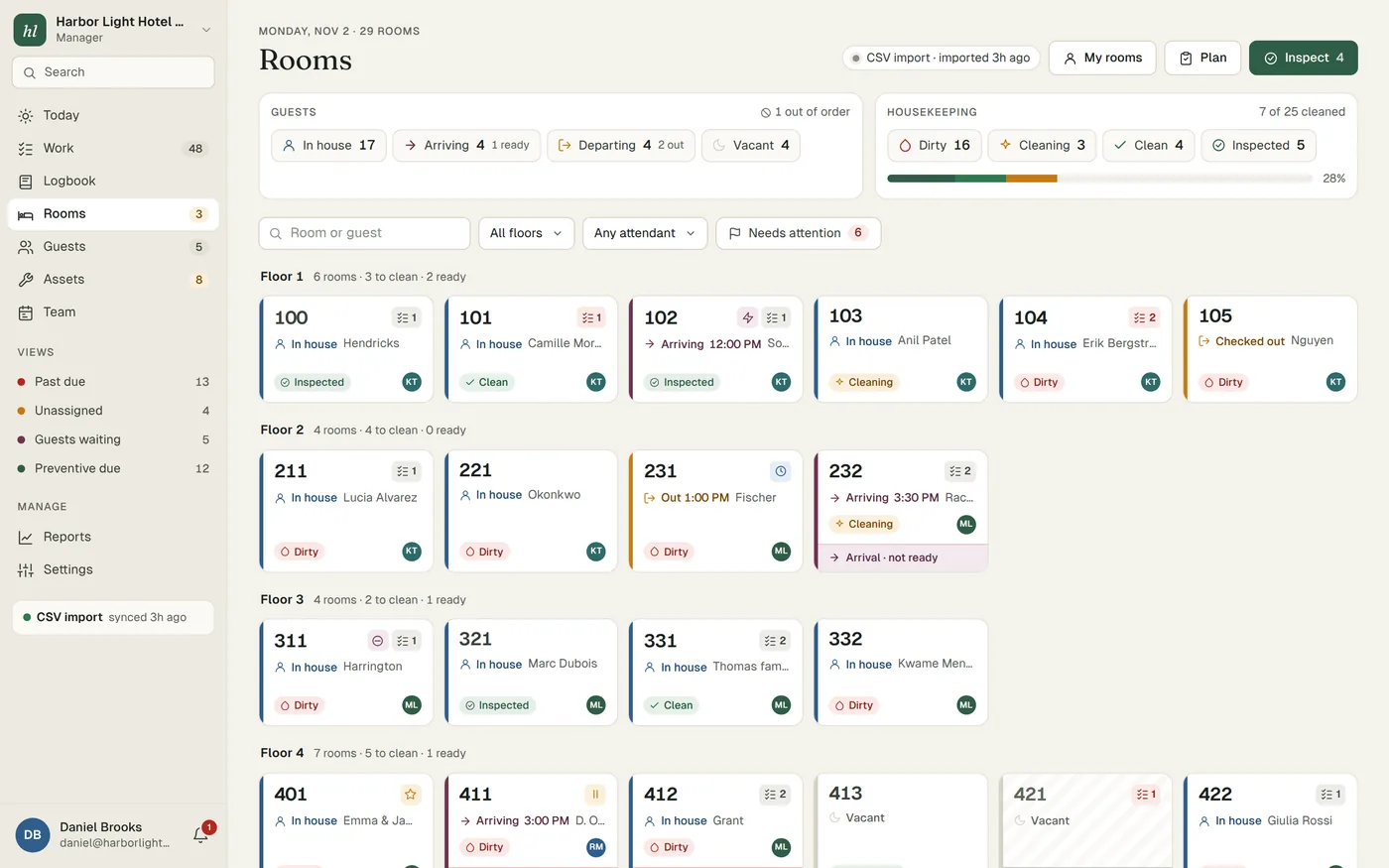
Paper inspection sheets work until someone has to act on them. In Turndown, the inspector reports a failed line from the room as a work order with a photo, and it lands in engineering's queue with a priority and a target time. The engineering room visit can run as a recurring routine with its own checklist, where required steps block the job from closing until they are ticked. A room held out of order stays held while its repair is open and is released when the job closes, coming back as dirty so it gets cleaned before it is sold. The housekeeping inspection loop, where a room goes from clean to inspected, is part of the housekeeping extras you can switch on in Settings at no extra cost. See how the room board works.