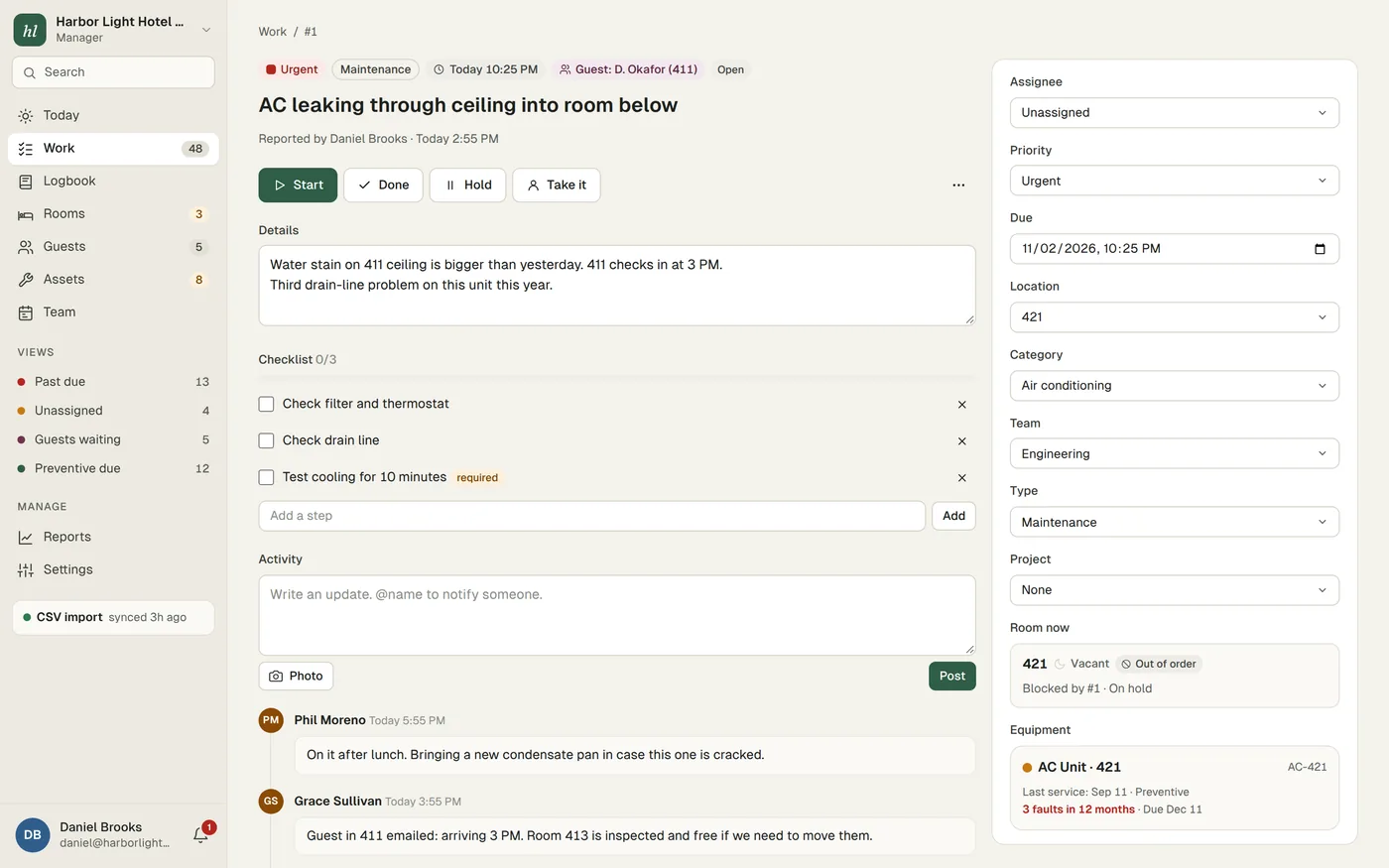
What a hotel work order needs
A factory work order is about a machine. A hotel work order is also about a room, a guest and an arrival time. These are the fields that make the difference.
| Field | Why it matters | Example |
|---|---|---|
| Number | So people can talk about one job without confusion. | #0412 |
| Room or place | Where to go. Use the room number or a named area, never "upstairs". | Room 214 |
| What is wrong | The symptom, in plain words, as specific as possible. | Shower drips after closing |
| Reported by and when | Who to ask for details, and how long the job has waited. | Maria, housekeeping, 9:40 AM |
| Guest affected | A guest in the room changes the priority and how you enter. | Yes, in house until Friday |
| Priority | Decides the order of work. See the table below. | Normal |
| Target time | When it should be done by. Without it, "soon" means never. | Today 9:40 PM |
| Out of order | Whether the room can be sold. The front desk needs to know. | No |
| Assigned to | One named person, not a team. | Victor |
| Parts used | For restocking, cost and the unit's history. | Cartridge, 1 |
| Time spent | Shows where the hours go. | 35 minutes |
| Closed by and when | Proof it was done, and the real resolution time. | Victor, 2:15 PM |
| Close note | What was done, so the next person knows the history. | Replaced cartridge, tested hot and cold |
| Photos | Before and after, especially for leaks and damage. | 2 attached |
Two fields carry more weight in a hotel than anywhere else. Guest affected decides whether the job jumps the queue. Out of order decides whether the front desk can sell the room tonight. Leave either one off and the engineering team and the front desk will work from different pictures.
The printable work order form
One form per job. Print a stack, keep them at the front desk and in the engineering office, and file them by number when they are closed.
| Work order | Fill in |
|---|---|
| Number | |
| Room or place | |
| What is wrong | |
| Reported by, date and time | |
| Guest affected (yes or no, until when) | |
| Priority (urgent, high, normal, low) | |
| Done by (date and time) | |
| Room out of order (yes or no) | |
| Assigned to | |
| Started | |
| Parts used | |
| Time spent | |
| What was done | |
| Closed by, date and time | |
| Room released to the front desk (time and initials) |
The last line matters. A room taken out of order for a repair should come back on sale the moment the repair is done, and someone has to tell the front desk. On paper, that someone is whoever closes the form.
The request log
Forms get lost. A log does not, because it is one sheet or one spreadsheet that every request goes into, in order. Use the log as the master list and the form as the job sheet, or use the log on its own in a small hotel.
| No. | Reported | Place | What is wrong | Guest | Priority | Assigned | Done |
|---|---|---|---|---|---|---|---|
| 0412 | Mon 9:40 AM | 214 | Shower drips after closing | Yes | Normal | Victor | Mon 2:15 PM |
| 0413 | Mon 10:05 AM | 305 | AC not cooling, guest in room | Yes | High | Phil | Mon 11:20 AM |
| 0414 | Mon 11:30 AM | Lobby | Two downlights out by the lifts | No | Low | Victor |
Each morning, whoever runs maintenance reads every open line. Anything without an owner gets one. Anything past its target gets a decision. Once a week, the whole list gets a proper look, as described in the guide to the weekly maintenance backlog review.
Priorities and target times
A priority is only useful if everyone agrees what it means. Write your rules down and print them next to the log. As an example, these are the starting targets in Turndown, which each hotel can change:
| Priority | Use it when | Examples | Example target |
|---|---|---|---|
| Urgent | Safety risk, or damage spreading now. | Water through a ceiling, a guest stuck in the elevator, a door that won't lock, sparks at a socket. | 30 minutes |
| High | A guest can't use the room properly, or an arrival depends on it. | AC not cooling with a guest in the room, no hot water, a toilet that won't flush. | 2 hours |
| Normal | Guests would notice, but the room still works. | A dripping tap, a stiff balcony door, one bulb out by the bed. | 12 hours |
| Low | Back of house or cosmetic, no guest impact today. | Paint touch-up in a corridor, a loose shelf in the linen room. | 3 days |
Two rules keep priorities honest. First, the person reporting suggests a priority, but the person who runs maintenance confirms it. Second, a guest complaint about a low-priority job raises it. A scuffed wall is low until the guest in the room mentions it at checkout.
How to write a request someone can act on
A good request saves a trip. The engineer should know where to go, what to bring and how urgent it is before leaving the workshop.
| Instead of | Write |
|---|---|
| AC broken | Room 305: AC running but blowing warm air since this morning. Guest in room, going out at 2 PM. |
| Leak in bathroom | Room 118: water on the floor behind the toilet after flushing. Towel down, guest checks out at 11. |
| Light out | Room 409: bedside lamp on the window side doesn't turn on. Bulb changed, still dead. |
| Check pool | Pool: pump making a grinding noise since 7 AM. Water clear, no smell. |
The pattern is place, symptom, since when, what was already tried, and the guest situation. A photo replaces a paragraph, which is one of the reasons paper starts to struggle.
Who can open a work order
Everyone. The housekeeper who finds a slow drain, the night auditor who hears a pump running at 3 AM, the server who sees a wobbly table on the terrace. The fastest way to lose a repair is to make people find the right person before they can report it.
- Housekeeping finds most room faults, because they are in every room every day. Give them a quick way to report from the cart, not a form at the end of the shift.
- The front desk takes guest complaints. Their request should say the guest is in the room and when they will be out, so engineering can plan the visit.
- Engineering opens its own jobs too. A fault found on rounds that can't be fixed on the spot becomes a work order, so it doesn't live only in someone's memory.
- Managers report what they see on walk-rounds, the same way as everyone else, so their jobs sit in the same queue and get the same priority rules.
Then one person, the chief engineer or whoever runs maintenance, reads every new request, confirms the priority and makes sure each job has an owner.
Four numbers to watch on the log
A log is also a report. Once a week, count four things:
- Open jobsHow many are still open. A number that grows every week means more work arrives than gets done.
- Past targetHow many have missed their target time. These are the jobs guests and managers will ask about.
- The oldest jobHow many days the oldest open job has waited. Old jobs are usually waiting on a part, a contractor or a decision.
- RepeatsPlaces that appear more than twice in a month. A room that needs three visits in four weeks has a cause nobody has found yet.
How to calculate these and what good looks like is in the guide to hotel maintenance KPIs.
Closing a work order properly
"Done" should mean the same thing every time. Before a job is closed:
- The fault is fixed and tested the way a guest would use it: the shower run hot, the AC run for ten minutes, the door closed from fully open.
- The area is clean. Dust sheets, old parts and packaging are gone.
- The close note says what was done, not just "fixed".
- Parts used and time spent are written down.
- If the room was out of order, the front desk and housekeeping know it is back, and it is cleaned before it is sold.
- If the guest reported it, someone tells them it is done.
Close notes are where repeat faults show up. Three notes saying "cleared AC drain, room 421" in six months is a sign the drain needs a regular check, not a fourth visit.
Download the template
This page prints as a clean form: use your browser's print command. For a version you can edit:
- Work order log, one-page form and priority table (Excel)
- Work order log (CSV, opens in Google Sheets or Numbers)
Change the priority targets to your own before you print, and agree them with the front desk, so a guest who is told "within two hours" gets it within two hours.
When paper stops working
A paper log works for a small, steady team. It starts to fail when requests arrive faster than one person can read them, when the night team can't see what the day team started, or when you need to know how many times the AC in 421 has been fixed this year. Then the forms become a pile, and the pile becomes a drawer.
A hotel work order app does the bookkeeping. In Turndown, anyone reports a job from their phone with a photo, guests can report from a QR code in the room, and every job gets a priority with a target time you set. Checklist steps marked as required block a job from closing until they are done. A vacant room with an open urgent or high-priority repair can't be marked clean without a supervisor's override, and a room held out of order is released when its job closes. The log, the history and the numbers are kept for you.