How to use this checklist
Air conditioning is the guest complaint that arrives at 11 PM, when the room is warm, the guest is tired and there is no spare room of the same type. Most of those calls start weeks earlier with a filter nobody washed or a base pan full of slime. A simple routine, done on time and written down, prevents most of them.
This page gives you that routine in four layers: what to do every month, every quarter, once or twice a year, and when to call a contractor. Every unit gets the same steps. The difference between a good program and a bad one is whether each room actually got its turn.
- Tag every unit. Put a label on each AC with its room number, such as AC-214. When a job says AC-214, nobody has to guess.
- Print one log per floor. The per-room log at the bottom of this page has a line for each visit. The page prints clean, without menus or buttons.
- Your manual wins. The intervals below come from GE, Friedrich and Amana PTAC manuals. If your model's manual says something different, follow it.
Downloads: the per-room AC log as a spreadsheet (XLSX) or as CSV for Google Sheets.
PTAC or split: what changes
A PTAC (packaged terminal air conditioner) is one box. It sits in a metal sleeve through the outside wall. The room side has the controls, the filters and the indoor coil. The outdoor coil sits behind the grille on the outside wall. Condensate collects in the base pan at the bottom of the unit and drains or evaporates from there. The whole chassis slides out of the sleeve, which is what makes deep cleaning possible.
A split system has two parts. The indoor head hangs on the wall with its filters, coil and blower wheel. The outdoor unit sits on a roof, a balcony or a bracket. Refrigerant lines and a condensate drain line run between them. Nothing slides out, so the indoor coil and blower are cleaned where they hang, usually with a coil cleaning bag to catch the runoff.
Both need the same three things: clean filters, clean coils and a drain that works. The schedule below covers both and says where they differ.
Every month: filters
This is the one task that makes the biggest difference, and the manuals agree on it. The GE Zoneline owner's manual says to "clean the filter at least every 30 days." The Friedrich PTAC manual says filters "should be cleaned at least monthly, and more frequently if conditions warrant." The Amana PTAC maintenance manual says the inlet air filter should be cleaned "once per month or more often."
- Switch the unit off before you touch the filters.
- Take the filters out and vacuum off the heavy dirt.
- Wash them in warm water with a mild detergent and let them dry fully before refitting.
- Replace any filter that is torn or bent. A missing or damaged filter lets dust straight onto the indoor coil.
- Wipe the front cover and the discharge grille with a damp, not wet, cloth.
- On PTACs with a fresh air filter, clean or replace it on its own schedule. Friedrich says after 3 months of use.
- Switch the unit back on, run it for 5 minutes and check the airflow is strong and even.
- Write the date and your initials on the room's log line.
Monthly is the minimum. Rooms near a beach, a building site or a dusty road clog faster, and so do rooms where guests leave the AC running with the balcony door open. A practical rule: if the filter is visibly grey at the monthly clean, that room needs a shorter interval. Keep a stack of clean spare filters so the swap takes two minutes and the wash happens in the workshop.
Every quarter: the room check
Once a quarter, give each unit a few more minutes while the room is empty. This is the visit that catches problems before a guest does.
- Do the monthly filter clean.
- Run cooling for 10 minutes and record the supply air temperature at the grille. Compare it with the last reading and with similar units on the same floor.
- Listen for rattles, grinding or a fan that is slow to start.
- Check the thermostat or remote responds and the display works. Replace remote batteries.
- Look for water where it should not be: on the sill, the wall below the unit or the carpet. On split units, look for stains under the indoor head.
- Sniff the air. A musty smell means slime in the base pan, the drain or the coil.
- Check the room side seal and the cabinet front fit well, with no gaps for unfiltered air.
- Make sure curtains, beds and furniture do not block the air inlet or outlet. Friedrich's install checklist warns about exactly this.
- From outside, check the PTAC grille or the split outdoor unit is clear of leaves, plants and stored junk.
A unit that blows noticeably warmer than its neighbors, or needed a call this month and last month, goes on the list for a deeper clean or a contractor visit now, not at the next scheduled service.
Once or twice a year: coils, base pan, sleeve and drain
Friedrich's manual says the indoor and outdoor coils and the base pan "should be inspected periodically (annually or semi-annually)" and cleaned of lint, dirt, leaves and paper, with more frequent cleaning "under extreme conditions." It gives the same interval for the inside of the wall sleeve and the drain system. In a hot or coastal hotel, plan on twice a year. In a mild climate with clean filters, once a year may be enough.
PTAC deep clean
- Unplug the unit or switch off its power before you start.
- Slide the chassis out of the wall sleeve. GE notes that dirt builds up on the inside of the outdoor coil, so you cannot judge it from the outside grille.
- Clean the indoor and outdoor coils with a soft brush and compressed air or a vacuum. If you use a pressure washer, use a gentle spray in the direction of the fins so they do not bend.
- Cover the electrical and electronic parts before any water goes near the unit.
- Use a biodegradable coil cleaner and degreaser. Friedrich says not to use a caustic cleaner on the coils or base pan.
- Clean the base pan. GE notes that a jelly-like substance can build up there in some areas.
- Clean the inside of the wall sleeve with an antibacterial and antifungal cleaner, rinse it, and check the drain outlets run freely.
- Check the sealant around the sleeve, inside and out, and reseal gaps.
- Check the sleeve still tilts slightly to the outside so condensate drains away from the room.
- Refit the chassis, run it in cooling and heating if it has heat, and log it.
Split unit deep clean
- Switch off the indoor and outdoor units at the isolator.
- Clean the indoor coil and the blower wheel. A coil cleaning bag keeps the runoff off the wall and the bed.
- Flush the condensate drain line and check it runs freely to its outlet.
- Clean the drain tray under the coil and check for cracks.
- Clear debris from the outdoor unit and gently clean its coil.
- Check the insulation on the refrigerant lines and the line cover outside.
- Check the outdoor unit is level and its bracket or pad is sound.
- Run the system for 10 minutes, record the supply air temperature and log it.
Split unit manuals vary more than PTAC manuals, so check yours for the coil and drain intervals.
Clean in place or pull the chassis
Filters, fronts and grilles are cleaned in place, in a few minutes, with the guest's things still in the room. Coils, base pans and sleeves need the PTAC chassis out of the wall. That turns a ten-minute job into an hour or more and usually means the room is off sale while it happens.
Two habits keep this cheap. First, rotate: pull the chassis on one floor or one wing each month, on days with spare rooms, so the year's deep cleans never collide with a sold-out weekend. Second, keep one or two spare chassis of your most common model. Swap the dirty unit for a clean spare, put the room back on sale, and clean the dirty one in the workshop. The preventive maintenance schedule builder shows how many AC jobs land in each week so you can see the load before you commit to it.
Drain pans, slime and smells
Water is the other half of AC trouble. Condensate that cannot get away grows slime, the slime blocks the drain, and the water ends up on the carpet or the guest's suitcase. Some water dripping from the outdoor side of a PTAC on a humid day is normal. GE's manual says so. Water inside the room is not.
Teach housekeeping to report four things: a musty smell when the AC starts, water on the sill or carpet under the unit, a gurgling or dripping sound, and stains on the wall below a split head. Each one is a work order, not a note on the room sheet.
For drain lines, algae treatment and mold in empty rooms, the guide to AC maintenance in hot, humid climates goes into detail.
Salt air and coastal rooms
Units on the sea side of the building corrode faster. Salt settles on the outdoor coil and the cabinet, the fins break down, and the unit loses capacity long before it fails. On coastal properties, check outdoor coils at every quarterly visit, rinse them with fresh water as your manual allows, and look for flaking fins, rust on the cabinet and corroded screws. Some PTAC models use coil end plates built to resist corrosion, which is worth asking about when you replace units on a sea-facing side.
When to call a contractor
In-house engineers can handle filters, fronts, coils, base pans, sleeves and drains. Call a licensed contractor for:
- Anything in the refrigerant circuit. Low charge, leaks, ice on the coil that comes back after the filter is cleaned. In the US, the EPA's Section 608 rules require technicians who service equipment that could release ozone-depleting refrigerants to be certified.
- Electrical faults. Tripping breakers, burnt smells, a compressor that hums but does not start.
- A unit that keeps failing. Three calls in six months on the same unit is a decision, not a repair: find the root cause or price a replacement.
- Coil cleaning at height. Outdoor units on roofs or high brackets need the right access and people trained to use it.
The per-room log
One line per visit. Tick what was done, write the supply air temperature on quarterly and deep clean visits, and initial it. Print as many copies as you have floors, or download the log as a spreadsheet.
| Room | Unit tag | Date | Filter | Coil | Drain or base pan | Supply air °F | Notes | Initials |
|---|---|---|---|---|---|---|---|---|
| 214 | AC-214 | Nov 3 | Washed | Checked | Clear | 55 | Remote batteries replaced | VH |
The first line is an example. The spreadsheet has a second tab with the schedule from this page, so the person doing the rounds has both on one clipboard.
Running it in Turndown
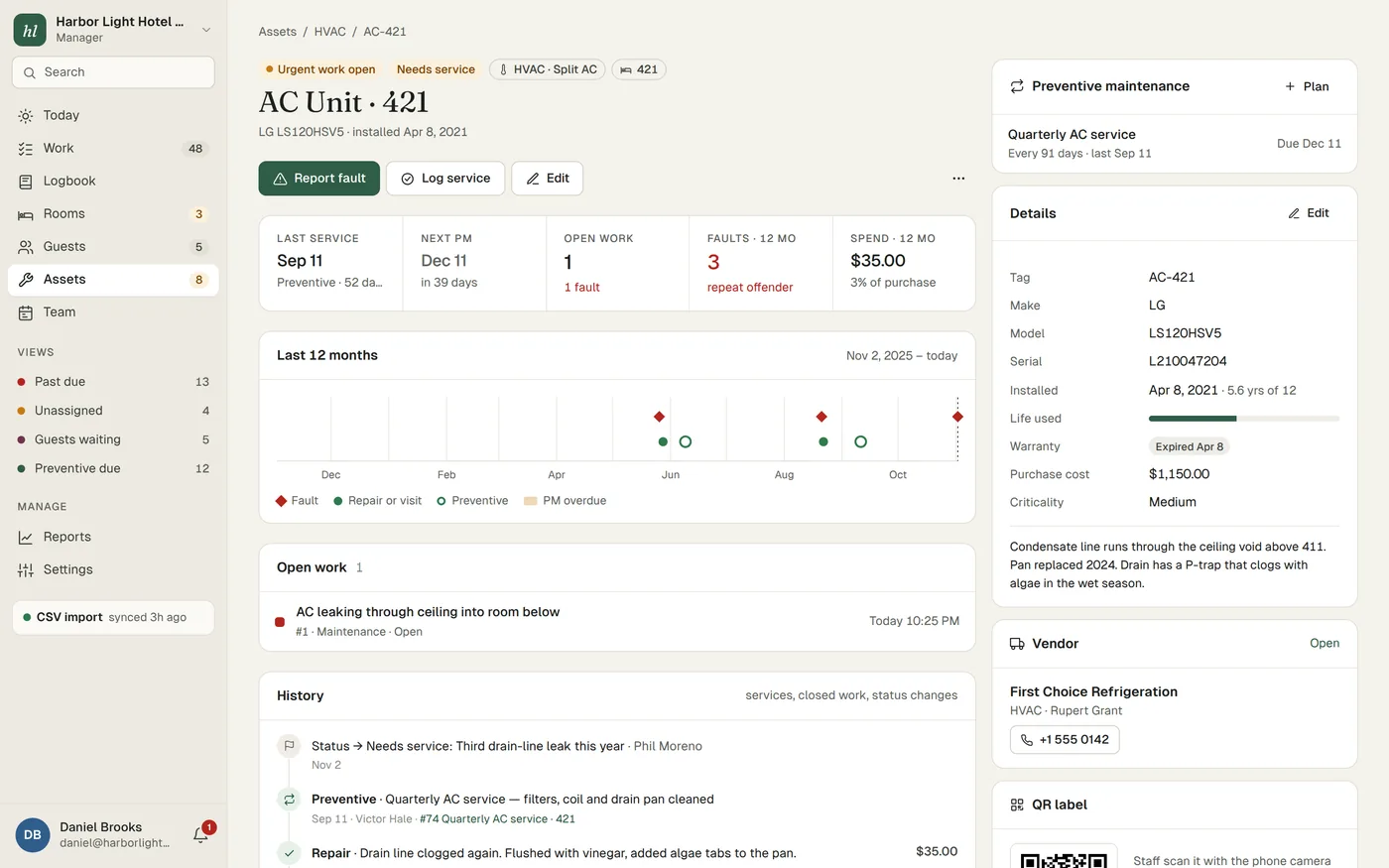
Turndown's guided setup adds an AC to every room in one step, tagged by room number like AC-214, and suggests two plans for them: a monthly filter clean and a quarterly AC service. The first round is spread over each plan's interval, so 80 filter cleans never land on one day. Each job arrives with its checklist, and the required steps, "run for 5 minutes and check the airflow" and "test cooling for 10 minutes and record supply air temperature", have to be ticked before the job can close.
Every service lands in the unit's history, and a printed QR tag on the unit opens that history for any signed-in engineer. A unit with three faults in six months is flagged as a repeat offender in the equipment insights and in the Monday backlog review. More about preventive maintenance in Turndown.