Three records, three jobs
Hotels often try to make one notebook do everything. It works better as three records, each with one job.
- The equipment maintenance logEverything done to each piece of equipment, planned or not, in date order. It answers: when was this unit last serviced, how often does it fail, and what has it cost us?
- The daily rounds sheetThe readings and checks taken on a fixed walk, every day. It answers: was everything running normally this morning, and when did that pressure start to drop?
- The work order logEvery repair request and what happened to it. It is covered in the hotel work order template.
Shift notes and handovers are a fourth record, kept by people rather than by equipment. The hotel shift handover template covers those.
The equipment maintenance log
Give every significant asset a tag and a line in the log each time anything is done to it. Tags work best when they follow the room or the area: AC-214 for the AC in room 214, GEN-1 for the first generator, PP-1 for the pool pump. The preventive maintenance schedule builder uses the same tags and produces a year of planned work you can log against.
| Date | Asset and tag | What was done | Type | Done by | Parts and cost | Readings | Next due |
|---|---|---|---|---|---|---|---|
| 3 Nov | Generator, GEN-1 | Weekly test run, 15 minutes. Fuel, oil and coolant checked. | Planned | VH | None | Hours 1,412. Fuel 3/4. | 10 Nov |
| 3 Nov | AC, room 214, AC-214 | Filter washed and refitted. Airflow checked. | Planned | PM | None | Outlet 13 °C | 3 Dec |
| 4 Nov | AC, room 421, AC-421 | Water dripping from indoor unit. Drain line blocked, cleared and flushed. | Repair | PM | None, 40 min | ||
| 5 Nov | Pool pump, PP-1 | Basket emptied, pressure checked, no leaks. | Planned | VH | None | Filter 14 psi | 12 Nov |
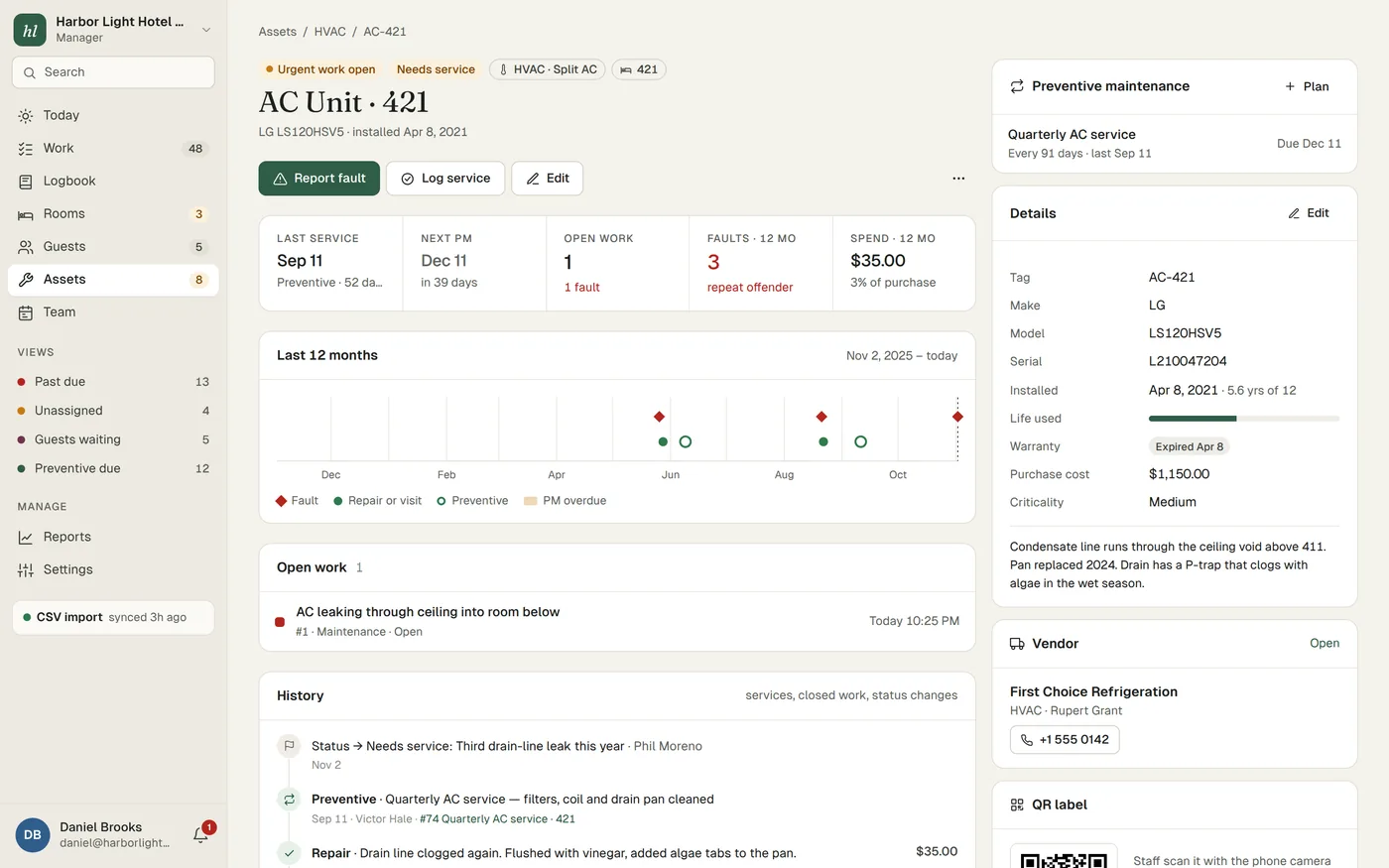
The Type column is what turns a log into information. Count the repair lines per asset and you have your repeat offenders. AC-421 with three drain repairs in six months needs a regular drain-line check, or a decision about replacement. The hotel maintenance KPIs guide shows how to turn that into a monthly number.
The daily engineering rounds sheet
Rounds are a fixed walk at fixed times, with the same checks in the same order. The value is in the readings. "Boiler OK" tells you nothing next week. "Hot water outlet 62 °C" tells you exactly when the temperature started to fall.
Adjust the list to your property. A villa resort has more pumps and pools and fewer corridors. A city hotel has an elevator and no generator room. Every line below asks for something you can write down.
Plant room, pumps and tanks
- Water supply pressure: write the gauge reading. Pumps start and stop on pressure, with no short cycling.
- Tank levels on every storage tank. Float valves not stuck.
- No leaks, drips or wet floors. No new noise or vibration from any pump.
- Water treatment or softener: salt level, filter pressure, no alarms.
Hot water and boilers
- Hot water storage temperature and return temperature: write both readings.
- Burner or heating elements running normally, no fault lights, no smell of gas or flue gas.
- Pressure relief valves dry, with no dripping from the discharge pipe.
Temperatures matter for more than comfort. The CDC's guidance on controlling Legionella in potable water systems advises storing hot water above 140 °F (60 °C) and keeping circulating hot water from falling below 120 °F (49 °C). Follow your own water management plan and your local code, and protect guests from scalding at the tap with the mixing valves your system was designed with.
Generator
- Fuel level: write it down. Day tank topped up.
- Battery charger on, no alarm lights, switch set to automatic.
- No oil, fuel or coolant leaks under the set.
- On test day, the run time and hours meter reading go in the equipment log.
Fire and life safety
- Fire alarm panel shows normal, with no faults or disabled zones. Write down any fault and who was called.
- Exit routes and fire doors clear. Exit signs lit.
- Extinguishers in place, pins and seals intact. Monthly visual checks are signed on the tag.
Kitchen and cold rooms
- Temperature of every walk-in cooler, freezer and reach-in fridge: write the reading, and compare it with the limits in your food safety plan.
- Door seals closing fully, no ice building up on evaporators, condensate drains clear.
- Ice machine making ice, bin clean.
Laundry
- Dryer lint screens cleaned. Lint left in a dryer is a fire risk.
- No water leaks around washers, no smell of gas at gas dryers.
Pool and spa
- Water chemistry readings go in the pool log, not this sheet. Note here that they were done and by whom.
- Pump running, gauge pressure normal, gate self-closing and latching.
Roof, outside units and grounds
- AC condensers running, fans turning, no debris or leaves blocking the coils.
- Roof drains and gutters clear, especially before forecast rain.
- Outside lights on their timer, car park and paths lit.
Public areas
- Lobby, corridors and restrooms: lights, temperature, smells, anything a guest would notice.
- Elevator: in service, alarm button and phone tested on its schedule.
- Automatic doors open and close, no trip hazards at entrances.
Rounds by time of day
| Round | When | Focus |
|---|---|---|
| Morning | Start of the day shift | Full round with all readings. Anything from the night handed over. |
| Afternoon | After check-out, before the arrival peak | Hot water and AC load at the busiest time. Rooms needed for arrivals. |
| Night | Late evening, by the night engineer or night manager | Exterior doors locked, perimeter lights, pool gate, plant room alarms, generator on automatic. |
In a small hotel without a night engineer, the night round often falls to the night auditor or security. Give them a short version: doors, lights, alarms, any water on floors, and a phone number for anything unusual.
Keeping a log that holds up
A log is evidence. Insurers, fire inspectors and health inspectors may ask for it, and so will you, the day something fails. These rules make it worth having.
- Date, time and initials on every lineAn entry nobody signed is an entry nobody can explain.
- Readings, not ticksWrite 62 °C, not a check mark. A tick hides the slow drift that comes before a failure.
- No blank linesIf a check was not done, write "not done" and why. A gap looks like the work never happened, and sometimes it means exactly that.
- Mistakes crossed out, not erasedOne line through the error, then the correction with initials.
- Contractor reports filed against the assetThe elevator, fire alarm and generator contractors leave reports. Put a line in the log and keep the report where you can find it by tag.
- Kept as long as it is neededSome periods are set in regulation. US workplace rules, for example, say the annual maintenance date of each portable fire extinguisher must be recorded and kept for one year after the last entry or the life of the shell, whichever is less, and that extinguishers are visually inspected monthly (OSHA 29 CFR 1910.157). Check what your insurer and local authorities require, and keep equipment logs for the life of the asset.
- Read every weekA log nobody reads only proves that warnings were written down. Look for repeat repairs and readings that are drifting.
Setting it up in an afternoon
- Walk the property with a notebook. List every piece of equipment that would cause trouble if it failed: plant, kitchen, laundry, pool, fire and life safety, and the units in every room.
- Tag it. A label with the tag on each unit, matching the log. The room number in the tag means nobody has to look anything up.
- Copy the rounds sheet and cut it to fit. Remove what you don't have, add what you do, and put the checks in the order you actually walk.
- Agree the normal readings. Write the normal range next to each reading on the sheet: the water pressure your system runs at, the temperatures in your water management and food safety plans. A reading outside the range is something to act on, not just to write down.
- Start both logs on a Monday. Fill in the equipment log for everything done that week, planned or not.
- Read them together after a month. Look for missed rounds, readings that drift and units that appear in the repair lines more than once. Adjust the sheet, then keep going.
Print it or download it
This page prints as a clean log and rounds sheet: use your browser's print command. For versions you can edit:
- Equipment maintenance log and daily rounds sheet (Excel)
- Equipment maintenance log (CSV, opens in Google Sheets or Numbers)
Print the rounds sheet weekly, one page per day, and keep the filled sheets in a binder by month. Keep the equipment log in the spreadsheet, so you can sort it by tag.
From a paper log to a service history
A spreadsheet log works until you need to see one unit's story while standing in front of it. In Turndown, every asset has a printable QR label. Scan it and signed-in staff see the unit's history, can report a fault or log a service on the spot. Each asset page shows twelve months of services and faults with their cost, vendors show what you spent with them over the year, and preventive maintenance plans create the work on schedule with their checklists attached. Shift notes and handovers live in the logbook, which is included. See how preventive maintenance works in Turndown.